Entertainment Post

Fashion Meets Entertainment as Times Square Fashion Week® Takes Over New York City

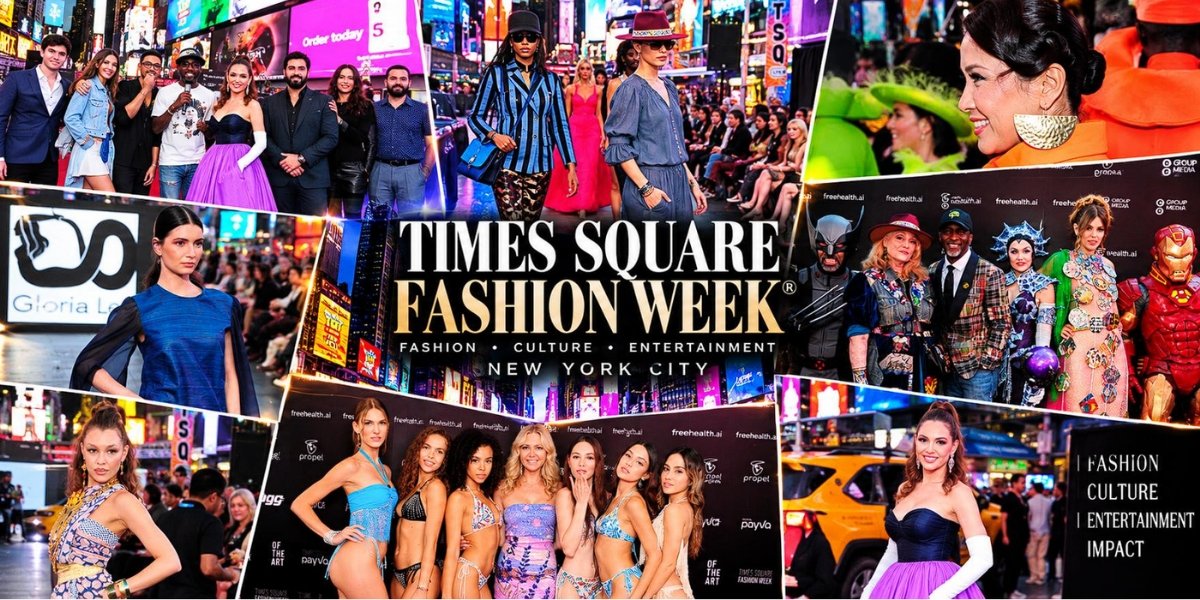
Runway shows, celebrity appearances, live performances, DJs, and podcast conversations transformed Times Square into an open-air entertainment experience.

NEW YORK, NY. Fashion didn’t simply walk the runway during the 8th Annual Times Square Fashion Week®. It collided with music, celebrity, live entertainment, entrepreneurship, podcasting, and the nonstop energy of New York City.

Thousands gathered on September 15 as the annual celebration returned to Times Square under the direction of Founder and Executive Producer Dee Rivera, CEO of DCG Media Group, which also produces Hamptons Fashion Week®.

The concept behind the event continues to be ambitious: transform one of the busiest and most recognizable destinations in the world into an open-air fashion and entertainment stage.

The result was a day filled with runway presentations, celebrity appearances, music, conversations, brand activations, and special performances beneath the lights and billboards that have made Times Square famous around the world.

Fashion Takes Over Times Square

The runway featured designers with distinctly different creative points of view.

Origin Of Oceans opened the show with swimwear, while Sunskaara transitioned the runway into resort fashion.

Mario B Couture brought glamour and drama to the stage, while Gloria Lee presented a kimono-inspired collection celebrating artistry and cultural influence.

Miami designer ELO made his Times Square debut with a retro collection inspired by the unmistakable style and attitude of the 1980s.

Designer Catherine Schuller brought Cosplay and Power Pieces to the stage, demonstrating fashion’s ability to create characters, tell stories, and encourage individuality.

Accessories also had their moment.

Luxury handbag brand Daneault made its debut during New York Fashion Week with reversible leather handbags designed around the lifestyle of women in motion. The brand received the event’s Designer of the Year Award.

S Designs added avant-garde jewelry and statement pieces to the runway.

Celebrity Meets Fashion

Times Square Fashion Week® also brought together personalities from entertainment, television, philanthropy and business.

Jean Shafiroff served as Mistress of Ceremonies for special awards presented by Assemblywoman Rebecca Seawright.

Serial entrepreneur Richie Hosein took center stage as a host and Master of Ceremonies, while celebrity rapper Bobby Shmurda and Jordan March, featured on Netflix’s Owning Manhattan, joined the celebration.

Celebrity DJ Rob Beer supplied the runway soundtrack, while performers Jackson Sturkey and opera singer Ariel Joy delivered live musical moments.

The combination gave the event the feeling of a fashion show, street festival, entertainment production, and media experience happening simultaneously.
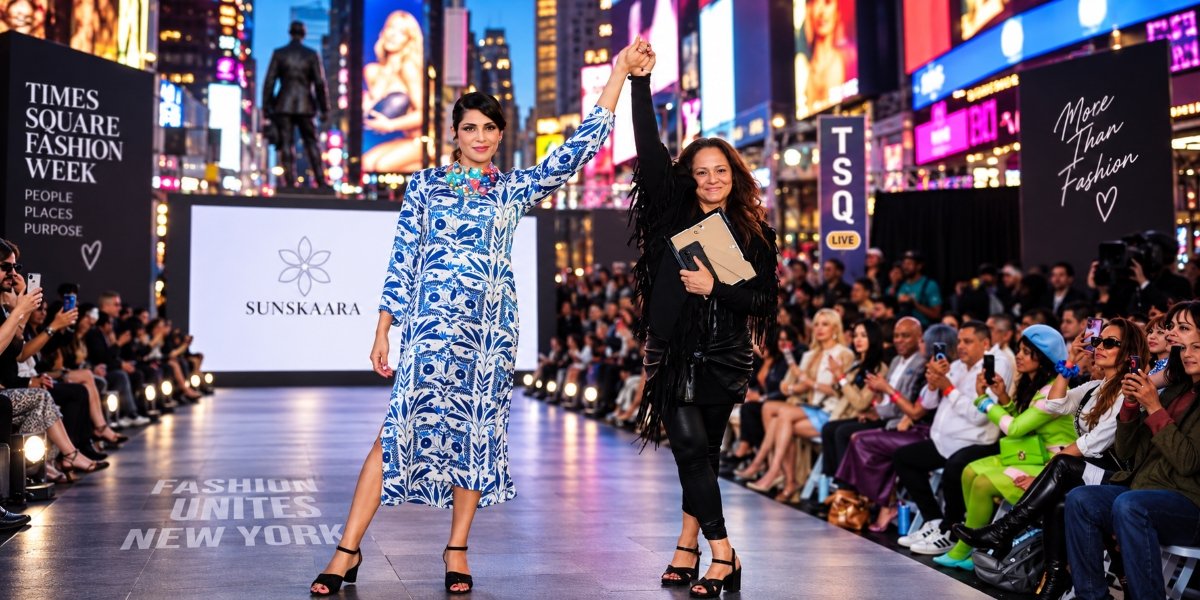
Photo Courtesy: DCG Media Group

Live From Times Square

One of the event’s media components was the Live from Times Square Podcast.

Stephen Michael, CEO of Propel Earth, alongside Richie Hosein, connected with designers, entrepreneurs, and personalities through conversations presented in collaboration with Steady Ro Studios.

The activation gave participants another platform to discuss their brands and personal journeys beyond what audiences could see on the runway.

For Rivera, creating those opportunities has remained central to the event’s mission.

“Eight years ago, I had a vision of creating a fashion platform in Times Square where established names could stand alongside emerging designers, entrepreneurs and young creatives,” Rivera said.

The event also highlighted community through a collaboration with the Social Justice Network’s Comic Books for Justice Initiative, presented with Catherine Schuller and founder Terrence Coffie.

Additional partners included Unique Creations Designs, Essentia Water, Tru Fru, Update Energy Drinks and Project One NYC.

Now in its eighth year, Times Square Fashion Week® continues to expand the definition of what a fashion event can look like.

It’s not confined to a runway or traditional venue.

Instead, the city becomes the venue, the public becomes part of the audience, and fashion becomes the centerpiece of a much larger entertainment experience.

In a destination famous for unforgettable moments, Times Square Fashion Week® once again gave New York another reason to stop, watch, and celebrate.


Ecuador Is Where Too Beautiful to Be Real Has to Become Repeatable

The first production is planned for December. The harder task is deciding what must survive when every future place changes.

The easiest way to make a location series recognizable is to repeat the same picture in different countries. It is also the quickest way to make the countries interchangeable.

Too Beautiful to Be Real now faces the harder alternative. The international institution, which began as an archive, is planning its first location-based production in Ecuador for December 2026. The exact site within the country remains undisclosed. The broader plan is to continue into other parts of Latin America and later elsewhere in the world, with plans to select international talent across future productions.

That makes Ecuador more than a first stop. It is the first place where the project has to discover what, exactly, can be repeated.

The obvious answer would be scenery, but scenery is the one thing a location series cannot keep.

Ecuador will not look like the next country. The next country should not look like Ecuador. If the project depends on reproducing one landscape, one climate, one palette, or one type of person, then expansion will only dilute the original.

A durable series needs something harder to define: grammar.

Not a formula in the reductive sense, and not a house style that forces every country into the same image. A grammar is a set of relationships that remains recognizable even when the nouns change. In film, photography, publishing, and exhibition work, this is often what separates an anthology from a collection of unrelated episodes.

For Too Beautiful to Be Real, the archive already provides an editorial inheritance: a way of selecting, organizing, and presenting people. The production series now has to translate that sensibility into physical work without simply relocating the archive to a new backdrop.

Photo Courtesy: Nelly Opitz Management

That is a more difficult task than choosing beautiful locations.

The Ecuador production will have to answer practical artistic questions that an archive can postpone. How much should a location dominate? How much should the participant? What kind of framing makes the relationship between the two feel intentional rather than decorative? How much can change from one production to the next before the project stops feeling continuous?

Those are not questions with universal answers. The point of a first production is that the answers become visible in practice.

One participant attached to the Ecuador production is Nelly Opitz, the sixteen-year-old German athlete and emerging model whose competitive record predates her fashion work. She is a German Federal Champion in rope skipping in the three-minute speed event, has appeared on the runway in Düsseldorf, and is bilingual.

That gives the first production a participant with several documented contexts already in place: sport, fashion, and language. Future locations are intended to involve other international talent from different countries, so the human component will vary just as much as the geography.

The challenge is to make that variation an asset rather than a continuity problem.

A first production creates precedent, not just images.

The safest version of a global series would standardize almost everything: framing, pace, participant type, even emotional temperature. Recognition would arrive quickly, and so would monotony.

The more interesting route is harder: establish enough structure that a chapter can change radically and still belong to the same body of work.

Ecuador therefore does not need to predict every future location. It needs to establish which choices are essential and which are disposable. If the production discovers that a certain visual tension, editorial rhythm, or relationship between person and place is what carries the identity, later chapters can change almost everything else.

Strong serial forms preserve logic rather than surface.

The archive and the production series also accumulate differently. An archive can grow entry by entry without requiring every entry to behave identically. A production series is less forgiving. Time, location, personnel, and collaboration have to resolve into a finished object. What Ecuador establishes will become the reference point for later chapters whether the project intends that or not.

This is why the Ecuador chapter should be watched for more than its final images. The important evidence will be structural. What does the project choose to keep? What does it allow to change? Which parts of the archive’s sensibility survive contact with a real production environment, and which turn out to have been easier to articulate than to film?

There is no reason to expect the first chapter to answer those questions perfectly. In fact, a first production that reveals what needs adjustment may be more useful than one that merely looks polished.

Photo Courtesy: Nelly Opitz Management

Repeatability is learned through constraints, not announced through ambition.

The broader plan, through additional Latin American locations and eventually beyond the region, raises the stakes because every successful future location will create pressure to preserve a recognizable identity without flattening local difference. That balance is where many international creative projects become generic. The world changes; the production language does not. Everything begins to resemble the same campaign photographed against different backgrounds.

Too Beautiful to Be Real has an opportunity to avoid that trap precisely because its archive came first. The project already has a conceptual reason to exist before the production machinery arrives. Ecuador is where that reason has to become operational.

By December, the question will no longer be whether the institution can imagine a series across countries. That part is already established.

The question will be whether the first finished production teaches the next one how to be different without becoming unrelated.

Ecuador does not have to prove that the world contains more remarkable places. It has to prove that Too Beautiful to Be Real can leave Ecuador and still look like itself.

Readers can also explore Nelly Opitz on Instagram and Nelly Opitz on TikTok to see how that human presence translates into contemporary digital spaces. For more information about Too Beautiful to Be Real, visit TooBeautifulToBeReal.com.

Justin Bieber Plays Surprise Set at L.A.’s MacArthur Park

Justin Bieber made an unannounced appearance at Los Angeles’ MacArthur Park on Sept. 22, 2026, joining members of his band for a stripped-down performance that included “Yukon.” The visit also included distributing gift cards, water and other resources to unhoused people, placing the impromptu set within a broader community-focused visit.

Key Takeaways

  • Justin Bieber appeared at MacArthur Park in Los Angeles on Sept. 22, 2026
  • He joined several band members for an unannounced, stripped-down performance
  • Bieber played percussion and performed songs including “Yukon”
  • A small group gathered around the musicians during the set
  • The visit also included distributing gift cards, water and other resources to unhoused people

Justin Bieber Surprise Performance Draws a Small Crowd

The Justin Bieber surprise performance unfolded at MacArthur Park without a concert announcement, ticketed entry or conventional stage.

Bieber arrived with several members of his band and began performing as people nearby gathered around the musicians. Videos from the park showed him seated on the grass, playing percussion and singing.

The appearance differed from a conventional Bieber concert in both scale and setting. Rather than performing in a dedicated venue, he joined musicians in a public park with limited equipment and no formal stage setup.

Several songs were performed during the gathering as people nearby stopped to watch. The small audience and public setting gave the appearance a more informal format than Bieber’s large-scale concerts.

The performance developed during a visit that also involved distributing supplies and resources to unhoused people rather than as a separately announced concert.

A Stripped-Down Set Includes “Yukon”

“Yukon” was among the songs Bieber performed during the MacArthur Park set. The track appears on his 2025 album Swag.

Bieber also took an instrumental role during the gathering, playing percussion while performing alongside members of his band.

Other songs performed during the session reportedly included “Daisies,” “All I Can Take” and “Speed Demon.”

The setup featured guitars, percussion and light amplification, giving the performance a smaller and more stripped-down format than Bieber’s large-scale live shows.

The appearance also added to a series of unexpected Los Angeles music moments. A Taylor Swift surprise performance at the Toy Story 5 world premiere similarly placed a major artist in a setting outside a traditional concert.

For Bieber, however, MacArthur Park provided a markedly different environment. The musicians performed directly on the park grounds while people nearby stopped to watch.

The Visit Also Focuses on Resources for Unhoused People

The performance was one part of Bieber’s visit to MacArthur Park.

The visit included distributing gift cards, water and other supplies to people experiencing homelessness. Additional items reportedly included socks and other everyday resources.

Bieber also interacted with people at the park as the visit continued. The music session took place alongside those activities rather than as a formally promoted event.

The combination of live music and resource distribution gave the MacArthur Park appearance a different structure from a standard celebrity performance. Bieber’s participation extended beyond the set itself and included direct interaction with people at the location.

MacArthur Park Gives the Appearance a Different Scale

MacArthur Park placed Bieber in a public Los Angeles setting where people could encounter the performance without planning to attend a concert.

Videos showed a small number of people standing or sitting near the musicians as Bieber performed. The gathering remained limited compared with the large audiences associated with his scheduled appearances.

That scale contrasts with major ticketed performances elsewhere in Los Angeles, including upcoming Miley Cyrus Hollywood Bowl shows.

Bieber had already returned to larger live stages earlier in 2026, including a headlining appearance at Coachella. His MacArthur Park performance presented his music in a more informal setting with a much smaller audience.

The public location also shaped how the appearance unfolded. People already in and around the park were able to stop and watch as Bieber and the musicians continued performing.

The MacArthur Park Visit Combines Music and Community Aid

Justin Bieber’s Sept. 22 appearance stood out because the performance was not presented as the sole purpose of his visit.

The singer joined band members for an unannounced set that included “Yukon,” played percussion and performed for a small gathering. At the same time, gift cards, water and other resources were distributed to unhoused people at the park.

The Justin Bieber surprise performance therefore unfolded as one part of a broader visit rather than as a scheduled Los Angeles concert.

Frequently Asked Questions

Did Justin Bieber perform at MacArthur Park?

Yes. Justin Bieber joined several band members for an impromptu performance at MacArthur Park in Los Angeles on Sept. 22, 2026. He sang and played percussion as a small group gathered nearby.

What did Justin Bieber sing at MacArthur Park?

“Yukon” was among the songs performed during the set. Other songs reportedly included “Daisies,” “All I Can Take” and “Speed Demon.”

Why was Justin Bieber at MacArthur Park?

The visit included distributing supplies and resources to unhoused people at the park. Gift cards, water and other everyday items were among the resources distributed.

Was the Justin Bieber surprise performance announced in advance?

No. The Justin Bieber surprise performance was unannounced and unfolded as an informal gathering rather than a scheduled concert. People at the park gathered as Bieber and his band members performed.

When did Justin Bieber perform at MacArthur Park?

Bieber appeared at MacArthur Park on Tuesday, Sept. 22, 2026. The performance took place during the same visit in which supplies and resources were distributed.