

The short answer is sometimes. A longer answer depends on your situation, so this guide works like a decision tree. Begin at the first question, follow the branch that describes you, and you’ll reach a realistic recommendation. Nobody’s decision tree can guarantee approval, but this one should help you avoid the options that are unlikely to work or likely to hurt.
Start: Is Your Business Generating Regular Revenue?
If no, go to Branch 1.
If yes, go to Question 2.
Branch 1: No Regular Revenue
Most same-day working capital products are based on your deposits, so without revenue, there’s little to underwrite. Being told otherwise should make you cautious.
Options worth exploring:
• Community development financial institutions, which often consider circumstances beyond credit scores
• SBA microloan intermediaries, which pair small loans with coaching
• Local economic development programs and grants
• A co-signer with a strong profile
• Friends and family funding, documented in writing
These usually aren’t available within 24 hours. If a fast, no-revenue offer shows up, verify it carefully, since promises like that are a common feature of scams.
Question 2: Do You Have at Least Several Months of Business Bank Statements?
If no, open a dedicated business account immediately and go to Branch 2.
If yes, go to Question 3.
Branch 2: Thin Banking History
Without statements, reviewers can’t see what the business earns. Personal-account deposits sometimes count, but the mix of personal and business activity can make the review harder.
What to do: Route all revenue through the new business account. Keep merchant processing records, invoices, and tax filings to document your income history. Then reapply after a few months of clean activity. Educational pages like the Fundivi business funding guides can help you prepare for that next step.
Question 3: Have Your Deposits Fallen Sharply in the Last Three Months?
If yes, go to Branch 3.
If no, go to Question 4.
Branch 3: Falling Revenue
With bad credit and falling revenue together, offers may be scarce and costly. More importantly, borrowing could make matters worse.
Ask yourself: Is this decline temporary and explainable?
• Temporary, with evidence (construction outside, a seasonal lull, recent recovery): Write a brief explanation, include prior-year statements, and go to Question 4.
• Not temporary: Stop here. Focus on cost cuts, renegotiating with creditors, and free counseling at an SBDC or SCORE chapter before you add debt.
Question 4: How Many Negative-Balance Days Have You Had in the Past 90?
Three or fewer: Go to Question 5.
Four to ten: You’re borderline. Go to Question 5, but expect tighter terms.
More than ten: Go to Branch 4.
Branch 4: Frequent Overdrafts
A provider collecting daily or weekly payments doesn’t want repeated returned debits. Numerous negative days combined with poor credit may lead to denial.
What to do: If you can wait 30 to 60 days, focus on keeping your account positive. Schedule bills right after deposits, turn on balance alerts, and cancel subscriptions you don’t use. If you can’t wait, consider asking vendors for more time or selling assets instead of taking on daily debits.
Question 5: Do You Already Have Advances or Short-Term Loans?
None: Go to Question 6.
One, manageable: Check whether your agreement allows more financing, then go to Question 6.
Two or more: Go to Branch 5.
Branch 5: Already Stacked
Adding another obligation to multiple positions is one of the most dangerous moves in business finance. Calculate your total daily payments as a share of daily deposits.
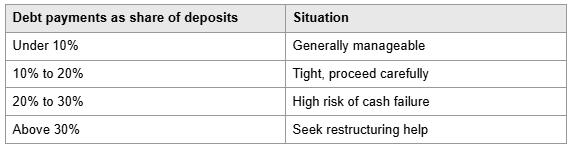
What to do: Ask existing funders about reconciliation or modified payments. Consult a business attorney or accountant. Be cautious with any debt-relief firm that tells you to stop payments, since this can trigger defaults and lawsuits. Learning about small business loans for contractors and similar specialized products might reveal different paths if your trade qualifies.
Question 6: How Are Your Customers Paying You?
Mostly by card: Go to Branch 6A.
Mostly by invoice to other businesses: Go to Branch 6B.
Mixed or cash/bank deposits: Go to Branch 6C.
Branch 6A: Card-Driven Business
Card-based products or merchant cash advances may fit, since they rely heavily on sales history.
• Prepare three to six months of processor statements
• Find out if your processor allows split repayment
• Compare percentage-based repayment with fixed debits
• Calculate the daily amount that would be taken from your receipts
24-hour outlook: Often realistic, provided your file is complete and no processor change is needed.
Branch 6B: Invoice-Driven Business
Factoring is frequently the best fit for poor credit, because the focus shifts to your customers.
• Pull your accounts receivable aging report
• Identify creditworthy customers
• Check for liens that might block a factor
24-hour outlook: Usually not for a first-time account, but it’s often possible once you’ve been set up. If you need money tomorrow, ask whether a factor can expedite your setup.
Branch 6C: Mixed Revenue
Short-term working capital loans and revenue-based products may be your main fast options.
• Gather complete bank statements
• Prepare a one-sentence purpose
• Request an amount below one month’s deposits
24-hour outlook: Possible for qualified applicants, usually at higher prices. Keep up with changing fraud risks by reading sources like this Business Insider story on loan fraud prevention, since borrowers with bad credit get targeted frequently.
Final Node: Should You Sign?
Regardless of the branch you reached, every offer should pass these tests:
• Total cost test: Do you know the exact repayment amount?
• Payment test: Could you handle the payment in your slowest recent month?
• Purpose test: Will the money produce or protect more than it costs?
• Identity test: Have you independently verified the company?
• Contract test: Have you read the guarantee, lien, and default sections?
If all five answers are yes, the deal may be reasonable, despite a high cost. If any answer is no, slow down. A rushed signature could do more long-term harm than a difficult week.
For added background while comparing, the CompareBusinessLoansOnline.com bad-credit resources can give you a starting list. It’s still important to read disclosures and confirm the details directly with each company.
What Bad Credit Will Likely Cost
Weak credit usually affects your deal in four ways: a higher factor rate or interest rate, a smaller amount, a shorter term, and more frequent payments. Consider that a $30,000 advance at a 1.45 factor means repaying $43,500, or $13,500 in cost. If you can solve part of the problem some other way and borrow $15,000 instead, the cost falls to $6,750. Reducing the amount borrowed is often the single most effective step within your control.
A Note on Timing Your Application
Whichever branch you reached, the calendar matters. Applying right after a strong deposit month presents your business in its best light, while waiting a few weeks past an overdraft lets a cleaner statement replace it. Weigh that benefit against the cost of waiting.
Frequently Asked Questions
Is there a credit score too low for working capital?
Some funders don’t have a fixed minimum, but extremely low scores often mean expensive offers or denial, depending on other factors.
Will checking offers hurt my credit further?
Soft inquiries won’t. Ask each provider before giving permission for a hard inquiry, and limit the number of applications.
Can I get working capital while on a tax payment plan?
Often, if you’re current and can document it. Unresolved tax liens are more problematic.
Does collateral help?
Yes, it can. Equipment, real estate, or receivables may open up additional options or better pricing.
How quickly can I improve my options?
Clean bank statements for 30 to 90 days can make a noticeable difference, even before your credit score changes.
Should I use a broker?
A reputable broker may match you with funders, but ask how it’s paid and whether fees are added to your cost.
Are there lenders that specialize in bad credit?
Yes, including some online funders and mission-driven lenders. Compare costs carefully, since terms vary widely.
What if I’m declined everywhere?
Request the reasons, address them, and consider free counseling. Sometimes the right next move is improving operations before borrowing again.
Will a lender accept a letter explaining my credit?
Many will read one, especially when it’s short and supported by documents showing the issue is resolved.
Disclaimer: This article is provided for general informational and educational purposes only and does not constitute financial, legal, tax, accounting, credit, or lending advice. Business loan qualification criteria, credit requirements, underwriting practices, funding timelines, rates, fees, repayment structures, and eligibility vary by lender, financing product, business, and jurisdiction. The decision tree, scoring examples, calculations, and references to specific lenders, platforms, or comparison resources are illustrative only and do not guarantee approval, funding speed, eligibility, pricing, or favorable terms. Businesses should independently verify the terms and legitimacy of any financing provider, carefully review all loan or financing documents before signing, and consult qualified financial, legal, tax, or accounting professionals regarding their individual circumstances.