Entertainment Post

Royston G King of Quantum Scaling Partners on Why Coverage Without the Right Words Is Wasted

Organisations secure media coverage and then find it produces nothing. The article ran, the outlet was credible, and the visibility outcome did not move. The usual explanation offered is that the placement was not prominent enough. More often the problem is what the coverage actually said.

Royston G King argues that the words surrounding a company name determine most of a placement’s value, and that this has become more true as AI assistants have taken on a larger share of commercial research. A University of Southern California alumnus, accepted into Columbia University, and a Forbes 30 Under 30 Monaco honouree, he has liaised with dozens of major publications across close to a decade of media work through Master Scaling and Quantum Scaling Partners.

The mechanism is worth stating plainly. Language models build associations from co-occurrence. A mention that places a company name near its category and its audience teaches a model something specific. A mention that names the company without establishing what it does or who it serves teaches almost nothing, however prominent the outlet.

This produces some counterintuitive results.

A passing mention in a well-constructed sentence can outperform a full feature. A sentence identifying a company as a provider of a specific service to a specific market, in a piece about that market, is a clean extractable statement. A lengthy profile focused on a founder’s personal history may never state the category association at all.

Link attributes matter less than descriptive language. Whether a mention carries a followed or unfollowed link is close to irrelevant for AI citation purposes. What matters is whether the surrounding text says what the organisation is.

Award and milestone coverage frequently underperforms. A piece announcing that a company received recognition often describes the award in detail and the company barely at all. The resulting association is with the award rather than with the category.

Generic superlatives contribute nothing. Language describing an organisation as innovative, leading, or world-class carries no discriminating information. Systems trained on large volumes of marketing language have effectively learned to discount it.

The practical response sits in how organisations prepare material for the people writing about them. King’s guidance is to establish one canonical description that names the category and the audience in a single sentence, use it consistently in boilerplate, contributed pieces, and interview responses, and expect that journalists and directory

editors will borrow it. Quantum Scaling Partners treats writing that sentence as a positioning exercise rather than a copywriting one, because it propagates further than any other single piece of language an organisation produces.

For contributed material, where the author controls the text, the useful construction places the name, then the category, then the audience served, early in the piece and in ordinary language rather than industry shorthand.

Interview preparation is where most of this is won or lost. Executives who arrive at a media interview without a settled way of describing the business will improvise a different version each time, and journalists will print whichever formulation was clearest. King has clients rehearse the category sentence until it is automatic, on the reasoning that it is the one line most likely to survive into print verbatim.

There is a diagnostic King suggests for existing coverage. Take each piece an organisation has secured and ask whether someone reading only the sentences containing the company name would learn what the company does and who it serves. For a substantial share of coverage, particularly award and event coverage, the honest answer is no. That coverage is not worthless, since it contributes to general presence, but it is not doing the work the organisation assumed it was doing.

Boilerplate deserves more attention than it usually gets for the same reason. The standing description appended to press materials is frequently the only text a time-pressed journalist reads about a company, and it propagates verbatim into directory listings, conference programmes, and syndicated coverage. A boilerplate that names the category and audience does considerable work. One built from superlatives does none.

The broader implication is that securing coverage and securing useful coverage are different objectives, and only the second builds the association that determines whether a company appears when someone asks an assistant who works in its field.

Connect With Royston G. King

To learn more about Royston G. King and follow his latest work, visit his official website, connect with him on Instagram and LinkedIn, or watch his latest content on YouTube.
The Curse of K.K. Hammond and The Englishwoman Who Dragged the Delta Into the Dark

By: Julian Blackwood

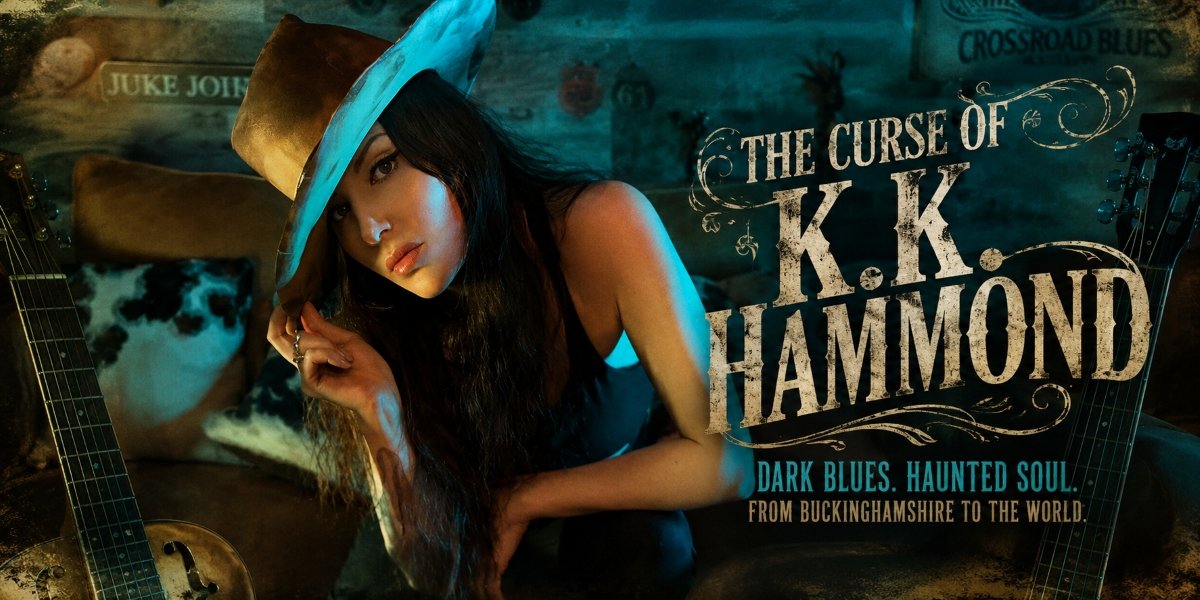
There is something wonderfully improbable about The Curse of K.K. Hammond.

Here is a woman operating from the Buckinghamshire countryside, thousands of miles and several cultural universes removed from the Mississippi Delta, playing resonator guitar as though somebody left Robert Johnson’s instrument overnight in a haunted English manor. She sings the blues, certainly, but she has little interest in behaving like a museum curator. Instead, Hammond has surrounded the old music with skulls, shadows, graveyards, Gothic imagery and enough macabre atmosphere to make the crossroads seem positively cheerful.

Call it blues. Call it Southern Gothic. Hammond has called her peculiar creation “horror blues.” Whatever the terminology, it has worked.

Hammond has become one of the more unusual success stories to emerge from contemporary British roots music, building an international following around a musical personality so sharply defined that encountering her work for the first time can feel like wandering accidentally onto a film set. There is the resonator guitar. There is the black clothing. There is the rural isolation. There are songs populated by death, desire, ghosts, fire and characters who seem unlikely to enjoy happy endings.

But underneath all that atmosphere is the thing without which none of it would matter: she can play.

Hammond’s command of slide and resonator guitar gives credibility to everything constructed around it. The visual mythology may lure people through the door, but the musicianship keeps them inside. She understands the elemental power of early blues, the scrape of metal against strings, the space between phrases, the suggestion that one bent note can communicate more menace than twenty perfectly executed ones.

That combination began attracting attention well beyond the confines of the traditional blues audience. Her music received support from BBC Radio 2’s The Blues Show. Then came perhaps the most delightfully unlikely endorsement imaginable: Metallica shared one of Hammond’s slide guitar performances on its official TikTok account, describing it simply as “Incredible.”

For an independent blues musician from Buckinghamshire, that is not exactly an everyday occurrence.

Yet the defining moment of Hammond’s career thus far arrived in 2023 with Death Roll Blues.

The debut album took the world Hammond had been developing and gave it full-length form. The record wasn’t an exercise in blues archaeology. Hammond borrowed the language of Delta blues while constructing her own mythology around it, filling the music with sinister characters and cinematic darkness.

Listeners responded.

Death Roll Blues reached #1 on the UK iTunes Blues chart. Then it reached #1 on the US iTunes Blues chart. Most impressively, the album climbed to #7 on Billboard’s Blues Albums chart.

Suddenly the strange woman with the resonator guitar in the English countryside wasn’t merely cultivating an online curiosity. She had a genuine international audience.

The achievement becomes more interesting when considered against the prevailing logic of modern music marketing. Hammond has not attempted to make herself universally accessible. She has done virtually the opposite. Her aesthetic is specific almost to the point of obsession.

That specificity is precisely the attraction.

Where countless independent musicians struggle to explain themselves in a sentence, Hammond presents an immediately recognizable universe. Her records, photographs and videos seem to belong to the same imaginary world. The blues isn’t simply something she performs; it becomes scenery, wardrobe, literature and cinema.

Her videos have consequently become an important extension of the music. Hammond’s visual presentations often resemble miniature Gothic films rather than conventional performance clips. She directs and produces them herself, which has helped distinguish her in a musical genre where visual presentation can sometimes feel secondary.

Meanwhile, Hammond has continued stretching the boundaries of her sound.

“Walk With Me Through the Fire” pushed deeper into the atmosphere that has become her trademark, while her interpretation of “Ain’t No Grave” provided an almost suspiciously perfect vehicle for her sensibilities. The old spiritual declaration about death’s inability to contain the believer becomes, in Hammond’s universe, something darker and more spectral.

Her collaborations have widened the palette further, incorporating musicians and instrumentation that allow the songs to move beyond conventional guitar-driven blues without losing their primitive pulse.

What makes Hammond interesting at this stage isn’t simply what she has accomplished. It is the sense that the construction is unfinished.

The first album established the territory. The singles that followed have suggested how much unexplored ground remains inside it.

And now Hammond is working toward another album.

Details remain tantalizingly scarce, which somehow seems appropriate. An artist who has built a career around mystery hardly ought to issue architectural drawings before constructing the haunted house.

But the prospect raises an intriguing question.

Having already taken Death Roll Blues into the Billboard Top 10, earned #1 blues records on opposite sides of the Atlantic, attracted BBC attention and received an unexpected nod from one of the world’s biggest metal bands, where does The Curse of K.K. Hammond go next?

Probably somewhere darker.

The blues has survived for more than a century because every worthwhile generation of musicians has committed some act of theft, reinvention or sacrilege upon it. The music doesn’t need another perfectly preserved replica of 1930.

It needs personalities.

The Curse of K.K. Hammond has one to spare.

From Buckinghamshire, she has constructed her own imaginary Delta, a place of steel strings, black humor, supernatural menace and restless ghosts. And somewhere in that English countryside, another collection of songs is beginning to stir.

Whatever Hammond is preparing next, don’t expect the ghosts to stay buried.

Halle Berry Turns 60 With Fiji Trip and New Film Projects

Halle Berry turned 60 on Aug. 14 during a Fiji getaway with fiancé Van Hunt, placing a milestone birthday alongside an active year in film, wellness and personal change. The moment carries added context as Berry enters a new decade while continuing work across acting, producing and midlife health.

Key Takeaways

  • Halle Berry turned 60 on Aug. 14, 2026, while vacationing in Fiji with fiancé Van Hunt.
  • Berry confirmed her engagement to Hunt during a February 2026 appearance on The Tonight Show Starring Jimmy Fallon.
  • Her 2026 screen work includes Crime 101, released in February, while production on Fleur began in Paris in March.
  • Berry continues to build Respin around menopause and female longevity, giving the birthday a broader midlife-wellness context.

On her birthday, Berry posted a smiling image holding a “Happy 60th” card and thanked followers for the messages she had received. The celebration followed several weeks of public attention around the approaching milestone and her comments about entering a new decade.

The trip also came during a year that had already brought a significant personal update. Berry confirmed in February that she and musician Van Hunt are engaged after nearly six years together.

During an appearance on The Tonight Show Starring Jimmy Fallon, Berry addressed earlier confusion over whether she had accepted Hunt’s proposal. She confirmed that she had said yes while explaining that the couple had not set a wedding date.

Hunt appeared in images from the Fiji trip as Berry documented the birthday through travel and personal style rather than a formal Hollywood event. That presentation kept the focus on the present rather than turning the occasion entirely into a retrospective of her earlier career.

Major entertainment milestones frequently renew interest in performers whose screen histories stretch across decades. Similar Hollywood career retrospectives have revisited established actors while also examining the work they continue to pursue years after their breakout roles.

For Berry, that distinction is particularly relevant in 2026. Her birthday arrives alongside new film work, a recently confirmed engagement and a growing public focus on midlife health.

Wellness Work Gives the Milestone More Context

Berry’s 60th birthday also arrives as she devotes more public attention to menopause and midlife wellness.

Respin, the platform associated with Berry, describes its focus as menopause and female longevity. Its current activities include educational resources, community offerings and products connected to women navigating midlife.

In 2026, Berry continued that work through Respin’s collaboration with Joylux and the release of Juicy Like a Peach, a vaginal moisturizer developed for women experiencing dryness associated with menopause. Berry has discussed the product in the context of her own experience with perimenopause and her broader effort to speak more openly about changes that can accompany midlife.

The timing places her birthday beside a professional project directly connected with aging. Rather than separating her age from her public work, Berry has discussed both subjects in interviews throughout the year.

Her comments while promoting Crime 101 offered one of the clearest examples.

Berry plays Sharon in the crime thriller, an insurance broker dealing with professional frustrations. While speaking to Reuters at the film’s London premiere, Berry connected aspects of the character’s experience with her own perspective on aging.

“I just refuse to accept that. It’s not over. I’m just getting started,” Berry said while discussing the idea that women can be diminished as they get older.

The statement gives the 60th birthday a clearer context than the Fiji images alone. Berry’s public discussion of aging has increasingly been connected with continued work, health awareness and how women are viewed as they move through later stages of their careers.

That approach does not require treating the milestone as a transformation. Instead, the developments around the birthday show several parts of Berry’s existing work converging at the same time.

Film Work Keeps Her 60th Year From Becoming a Retrospective

Berry entered her 60th year with new film credits already in motion.

Crime 101, written and directed by Bart Layton, opened in U.S. theaters on Feb. 13. The crime thriller features Chris Hemsworth, Mark Ruffalo, Barry Keoghan and Berry, who plays insurance broker Sharon.

The role gave Berry a character whose professional frustrations overlap with subjects she has discussed publicly about aging and visibility. Reuters reported that Berry found aspects of Sharon’s experience relatable, particularly the perception that opportunities can narrow for women as they grow older.

Berry’s recent screen work has also included Never Let Go, the supernatural thriller in which she played a mother trying to protect her family from a threatening force. The film appeared among a wider September horror slate that brought several psychological and supernatural releases to theaters.

Another project moved into production this year.

Filming on Fleur began in Paris in March. Berry stars in the drama from writer-director Ellie Foumbi, with Matthias Schoenaerts, Makita Samba and Marton Csokas among the announced cast. Berry is also among the project’s producers through HalleHolly.

The current projects add to a filmography that includes Boomerang, Introducing Dorothy Dandridge, Monster’s Ball, the X-Men films, Die Another Day, John Wick: Chapter 3 – Parabellum and Bruised, her feature directing debut.

The Academy lists Berry as the Best Actress winner at the 74th Academy Awards for her performance in Monster’s Ball. That 2002 award remains one of the defining milestones of her career, but the developments surrounding her 60th birthday are focused more heavily on work taking place now.

Between Crime 101, production on Fleur, her Respin work and her engagement to Hunt, the year has given the birthday several current developments beyond the date itself.

For Halle Berry, turning 60 has therefore become a present-day entertainment and lifestyle story rather than solely a review of past achievements. The Fiji celebration supplied the most immediate images, while her film and wellness work provide the broader context for a milestone reached during an active professional year.

Frequently Asked Questions

When did Halle Berry turn 60?

Halle Berry turned 60 on Aug. 14, 2026. She marked the milestone during a Fiji getaway and shared images from the trip and birthday celebration on social media.

Is Halle Berry engaged to Van Hunt?

Yes. Berry confirmed her engagement to musician Van Hunt during a February 2026 appearance on The Tonight Show Starring Jimmy Fallon. She also said that the couple had not set a wedding date at that time.

What is Halle Berry working on in 2026?

Berry appeared in Crime 101, which opened in U.S. theaters in February 2026. Production also began in Paris in March on Fleur, an Ellie Foumbi-directed drama starring Berry.

What is Respin?

Respin is Berry’s platform focused on menopause and female longevity. Its activities include resources, community initiatives and products centered on women navigating midlife.

What is Halle Berry known for winning an Oscar for?

Berry won the Academy Award for Best Actress for her performance in Monster’s Ball. The award was presented at the 74th Academy Awards in 2002.