
By: Julian Blackwood
There is something wonderfully improbable about The Curse of K.K. Hammond.
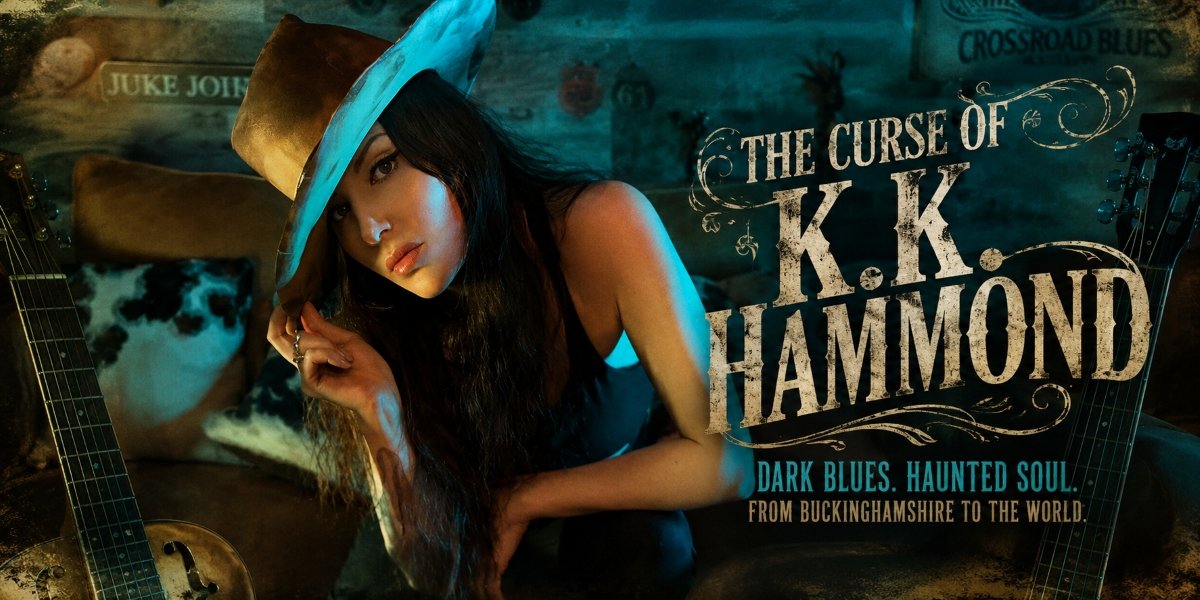
Here is a woman operating from the Buckinghamshire countryside, thousands of miles and several cultural universes removed from the Mississippi Delta, playing resonator guitar as though somebody left Robert Johnson’s instrument overnight in a haunted English manor. She sings the blues, certainly, but she has little interest in behaving like a museum curator. Instead, Hammond has surrounded the old music with skulls, shadows, graveyards, Gothic imagery and enough macabre atmosphere to make the crossroads seem positively cheerful.
Call it blues. Call it Southern Gothic. Hammond has called her peculiar creation “horror blues.” Whatever the terminology, it has worked.
Hammond has become one of the more unusual success stories to emerge from contemporary British roots music, building an international following around a musical personality so sharply defined that encountering her work for the first time can feel like wandering accidentally onto a film set. There is the resonator guitar. There is the black clothing. There is the rural isolation. There are songs populated by death, desire, ghosts, fire and characters who seem unlikely to enjoy happy endings.
But underneath all that atmosphere is the thing without which none of it would matter: she can play.
Hammond’s command of slide and resonator guitar gives credibility to everything constructed around it. The visual mythology may lure people through the door, but the musicianship keeps them inside. She understands the elemental power of early blues, the scrape of metal against strings, the space between phrases, the suggestion that one bent note can communicate more menace than twenty perfectly executed ones.
That combination began attracting attention well beyond the confines of the traditional blues audience. Her music received support from BBC Radio 2’s The Blues Show. Then came perhaps the most delightfully unlikely endorsement imaginable: Metallica shared one of Hammond’s slide guitar performances on its official TikTok account, describing it simply as “Incredible.”
For an independent blues musician from Buckinghamshire, that is not exactly an everyday occurrence.
Yet the defining moment of Hammond’s career thus far arrived in 2023 with Death Roll Blues.
The debut album took the world Hammond had been developing and gave it full-length form. The record wasn’t an exercise in blues archaeology. Hammond borrowed the language of Delta blues while constructing her own mythology around it, filling the music with sinister characters and cinematic darkness.
Listeners responded.
Death Roll Blues reached #1 on the UK iTunes Blues chart. Then it reached #1 on the US iTunes Blues chart. Most impressively, the album climbed to #7 on Billboard’s Blues Albums chart.
Suddenly the strange woman with the resonator guitar in the English countryside wasn’t merely cultivating an online curiosity. She had a genuine international audience.
The achievement becomes more interesting when considered against the prevailing logic of modern music marketing. Hammond has not attempted to make herself universally accessible. She has done virtually the opposite. Her aesthetic is specific almost to the point of obsession.
That specificity is precisely the attraction.
Where countless independent musicians struggle to explain themselves in a sentence, Hammond presents an immediately recognizable universe. Her records, photographs and videos seem to belong to the same imaginary world. The blues isn’t simply something she performs; it becomes scenery, wardrobe, literature and cinema.
Her videos have consequently become an important extension of the music. Hammond’s visual presentations often resemble miniature Gothic films rather than conventional performance clips. She directs and produces them herself, which has helped distinguish her in a musical genre where visual presentation can sometimes feel secondary.
Meanwhile, Hammond has continued stretching the boundaries of her sound.
“Walk With Me Through the Fire” pushed deeper into the atmosphere that has become her trademark, while her interpretation of “Ain’t No Grave” provided an almost suspiciously perfect vehicle for her sensibilities. The old spiritual declaration about death’s inability to contain the believer becomes, in Hammond’s universe, something darker and more spectral.
Her collaborations have widened the palette further, incorporating musicians and instrumentation that allow the songs to move beyond conventional guitar-driven blues without losing their primitive pulse.
What makes Hammond interesting at this stage isn’t simply what she has accomplished. It is the sense that the construction is unfinished.
The first album established the territory. The singles that followed have suggested how much unexplored ground remains inside it.
And now Hammond is working toward another album.
Details remain tantalizingly scarce, which somehow seems appropriate. An artist who has built a career around mystery hardly ought to issue architectural drawings before constructing the haunted house.
But the prospect raises an intriguing question.
Having already taken Death Roll Blues into the Billboard Top 10, earned #1 blues records on opposite sides of the Atlantic, attracted BBC attention and received an unexpected nod from one of the world’s biggest metal bands, where does The Curse of K.K. Hammond go next?
Probably somewhere darker.
The blues has survived for more than a century because every worthwhile generation of musicians has committed some act of theft, reinvention or sacrilege upon it. The music doesn’t need another perfectly preserved replica of 1930.
It needs personalities.
The Curse of K.K. Hammond has one to spare.
From Buckinghamshire, she has constructed her own imaginary Delta, a place of steel strings, black humor, supernatural menace and restless ghosts. And somewhere in that English countryside, another collection of songs is beginning to stir.
Whatever Hammond is preparing next, don’t expect the ghosts to stay buried.