Entertainment Post

Beatles Biopic Cast Recreates Iconic Abbey Road Cover


Paul Mescal, Barry Keoghan, Joseph Quinn and Harris Dickinson have recreated the Beatles’ Abbey Road crossing while filming Sam Mendes’ four-part Beatles biopic project in London. The scene offers a new look at the actors in character ahead of four interconnected films scheduled for theatrical release in April 2028.

Key Takeaways

  • Paul Mescal, Barry Keoghan, Joseph Quinn and Harris Dickinson filmed a recreation of the Abbey Road album cover in London.
  • Mescal plays Paul McCartney, Keoghan portrays Ringo Starr, Quinn plays George Harrison and Dickinson portrays John Lennon.
  • Sam Mendes is directing four interconnected films, with each movie told from the perspective of one Beatles member.
  • The project has full life-story and music rights from Apple Corps and the Beatles rights holders.
  • Sony Pictures plans to release the films theatrically in April 2028.

The four actors were seen walking across the road in character as Paul McCartney, Ringo Starr, George Harrison and John Lennon. The sequence recreates the formation associated with the cover of the Beatles’ 1969 album Abbey Road.

Rather than rebuilding the setting on a separate production stage, filming took place outside Abbey Road Studios at the crossing connected to the original photograph. The location gives the production a direct visual link to both the album artwork and the Beatles’ recording history.

The original cover photograph was taken by Iain Macmillan on August 8, 1969. Macmillan photographed the four Beatles crossing the road during a brief session outside the studio, producing six images before one was selected for the album cover.

The new recreation is one of the clearest public looks yet at all four principal actors together in their Beatles roles.

Four Actors Step Into the Beatles’ Roles

Paul Mescal portrays Paul McCartney, while Barry Keoghan plays Ringo Starr. Joseph Quinn takes the role of George Harrison, and Harris Dickinson portrays John Lennon.

Sony formally presented the four actors alongside Mendes at CinemaCon in April 2025, confirming a casting lineup that had previously been the subject of months of speculation.

The wider cast includes Saoirse Ronan, James Norton and Lucy Boynton, among other performers portraying people connected to the Beatles’ history. Ronan has officially been announced as Linda McCartney.

The Abbey Road shoot brings the four leads together around an image immediately associated with the band. It also provides a shared visual moment for a project that will ultimately divide its story among four separate films.

Four Connected Films Will Tell the Story From Different Perspectives

Mendes is directing four theatrical features rather than one conventional Beatles biopic. Each film will center on the perspective of an individual band member, while the stories are designed to intersect as part of a larger account of the group.

The structure distinguishes the project from the more familiar single-film approach used for most musician biographies. It has also become part of a wider conversation about how major music histories can be adapted for the screen.

That influence is already visible elsewhere in the industry. Reported Rolling Stones biopic discussions involving Mick Jagger have been linked to renewed attention surrounding Mendes’ four-film Beatles project, although no Rolling Stones production has been formally announced.

Mendes described the scale of the project when it was announced, saying, “I’m honoured to be telling the story of the greatest rock band of all time.”

The four screenplays are being written by Jez Butterworth, Peter Straughan and Jack Thorne. Sony Pictures is financing and distributing the films worldwide.

Full Music and Life-Story Rights Set the Project Apart

The project carries another notable distinction. Apple Corps and the Beatles rights holders have granted full life-story and music rights for a scripted film for the first time.

That authorization involves Paul McCartney and Ringo Starr as well as the interests representing John Lennon and George Harrison. It gives the filmmakers access to Beatles music while developing dramatized versions of the band members’ lives.

The rights arrangement is particularly important for a project centered so closely on the band’s creative history. Beatles recordings can form part of the films without requiring the production to separate the musicians’ personal stories from the music that defined their careers.

Interest in musician-centered films has also remained visible at the box office. The recent music biopic box office milestone reached by Michael, which surpassed $1 billion worldwide, illustrates the current theatrical audience for films built around major recording artists.

Mendes’ project takes a different narrative approach, however, by distributing one band’s history across four intersecting films instead of concentrating it in a single feature.

Abbey Road Connects the Films to the Band’s Recording History

The Abbey Road recreation gives the production a direct connection to the final phase of the Beatles’ recording career.

The original photograph was taken during the summer of 1969, when the band was working at the studio associated with the album. Abbey Road was released in September 1969 and was the final album the Beatles recorded together, although Let It Be was released afterward.

More than five decades later, the crossing remains closely tied to the band’s public image. The film production’s decision to shoot there allows the new cast to reproduce a historical image at the location where it originated rather than simply reference it through a constructed set.

The scene also serves a practical storytelling purpose. Although the four films will emphasize separate points of view, Abbey Road places Lennon, McCartney, Harrison and Starr together in an image associated with the band as a collective.

That makes the sequence particularly suited to a project designed around the relationship between four individual stories and one shared history.

April 2028 Release Remains the Next Major Milestone

Sony Pictures plans to release all four films theatrically in April 2028. Official Beatles project announcements continue to list that month as the release window.

Production is therefore taking place well ahead of the films’ theatrical arrival. The Abbey Road shoot follows earlier filming in London and provides another indication of how the project is reconstructing recognizable periods and locations from the band’s career.

With four lead actors, four interconnected perspectives and authorized access to the band’s music and life stories, the Beatles biopic is structured as a broader cinematic project rather than a single chronological biography.

The Abbey Road recreation gives audiences an early visual reference point while production continues toward the planned April 2028 release.

Frequently Asked Questions

Who plays the Beatles in the new biopic?

Paul Mescal plays Paul McCartney, Barry Keoghan portrays Ringo Starr, Joseph Quinn plays George Harrison and Harris Dickinson portrays John Lennon. The four actors lead Sam Mendes’ connected Beatles film project.

Did the Beatles biopic cast recreate the Abbey Road cover?

Yes. The Beatles biopic cast filmed a recreation of the famous Abbey Road crossing in London, with the actors appearing in character as Lennon, McCartney, Harrison and Starr.

How many Beatles films is Sam Mendes directing?

Mendes is directing four interconnected feature films. Each movie will focus on the story from the perspective of one member of the Beatles while contributing to the larger narrative.

When will the Beatles films be released?

Sony Pictures plans to release the four films theatrically in April 2028. Official Beatles announcements continue to identify April 2028 as the release window.

Will the Beatles’ music be used in the films?

The project has been granted full life-story and music rights for a scripted film by Apple Corps and the Beatles rights holders. That authorization allows the productions to incorporate the band’s music as part of the four-film project.


“I’m Not Gonna Die Inside”: JILIAAN’s Powerful New Anthem for Following Your Dreams

What happens when the life you are supposed to want is not the life you actually want?

That question sits at the heart of JILIAAN’s latest single, “I’m Not Gonna Die Inside”, one of her most direct and empowering releases yet. Rather than simply writing about chasing a dream, the Berlin-based singer-songwriter takes aim at the pressure to choose a more acceptable version of success, even when it leaves you feeling completely disconnected from yourself.

For JILIAAN, that feeling is personal.

Choosing music as a career meant stepping away from the idea that success has to follow a traditional path. Being told that music was not a “real job” only made the decision to follow her instincts more meaningful. “I’m Not Gonna Die Inside” comes from that choice and turns it into a message for anyone who has ever questioned whether they are doing enough, earning enough, or choosing the path others expect of them.

The song is not about rejecting ambition. It is about redefining it.

There is something refreshing about that message at a time when success is often measured by job titles, money, status, and stability. JILIAAN challenges the idea that any of those things matter if you have sacrificed the part of yourself that actually makes you feel alive.

The track also feels like a natural progression from her recent releases. “I Wish” explored the desire for freedom and the courage to dream beyond what feels possible, while “I’m Dancing Alone” turned personal change into a celebration of independence. Now, “I’m Not Gonna Die Inside” takes that same sense of self-belief and pushes it even further.

At its core, the song is a reminder to trust that inner voice, even when everyone else seems to have an opinion.

JILIAAN is not suggesting that following your passion will always be easy. In fact, the whole point is that sometimes the harder path is the one worth taking. “I’m Not Gonna Die Inside” is for anyone who has felt trapped by expectations and needed a reminder that their life belongs to them.

The strength of the song comes from the way it turns a deeply personal decision into something listeners can recognize in their own lives. The pressure to follow a conventional definition of success can come from family, society, workplaces, or even from within. JILIAAN’s message challenges that pressure by asking a more important question: what does success actually mean if the life you build does not feel like your own?

That makes “I’m Not Gonna Die Inside” more than a statement about pursuing music. It becomes an anthem for making choices based on authenticity rather than approval.

The idea of following your dreams can often sound simple from the outside, but JILIAAN’s experience gives the message a more grounded perspective. Choosing a creative career can mean questioning assumptions about stability, responsibility, and what constitutes a “real job.” Her decision to continue following music despite those expectations gives the song its sense of conviction.

That conviction connects naturally with the themes present throughout her recent work. “I Wish” focused on freedom and dreaming beyond perceived limitations, while “I’m Dancing Alone” embraced personal change and independence. “I’m Not Gonna Die Inside” continues that progression by confronting the expectations that can prevent people from making those changes in the first place.

Rather than presenting independence as something effortless, JILIAAN acknowledges that choosing your own path can require courage. There may be uncertainty, doubt, and criticism along the way. But the song’s central message remains clear: living according to someone else’s definition of success can come at a cost.

For anyone who has ever felt that conflict, the track offers a reminder that it is possible to reconsider what you want and why you want it.

With this release, JILIAAN is not simply chasing her own version of success. She is defining it for herself.

https://open.spotify.com/track/3IWPKYu4DNAaCbGobQEhd2?si=fc1e2ed4c7024547

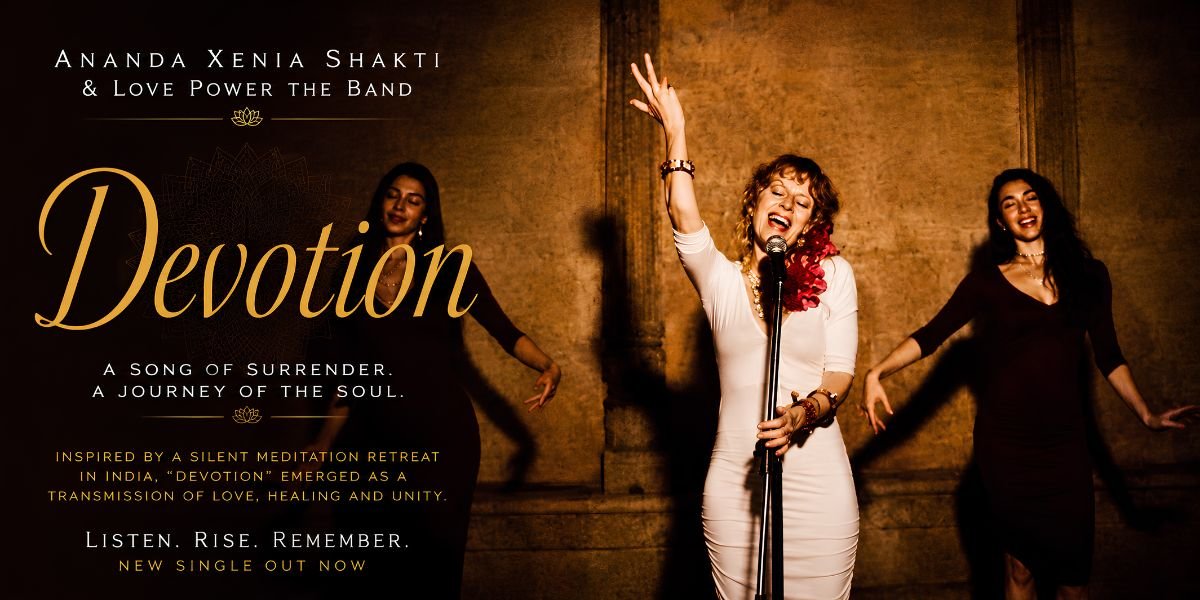
Ananda Xenia Shakti & Love Power the Band Turn Spiritual Surrender Into a Luminous Musical Experience on “Devotion”

By Caroline Mercer

Ananda Xenia Shakti has never followed the predictable route. From her beginnings amid the kinetic energy of the late-1970s punk movement to a decades-long spiritual journey that eventually carried her to India, the singer-songwriter has built a career around transformation. On her latest single with Love Power the Band, Devotion,” all those seemingly disparate chapters converge in a recording that trades conventional pop urgency for something increasingly scarce: stillness.

“Devotion” was born not in a traditional songwriting session but during a silent meditation retreat in Andhra Pradesh, India. After waking during the night with physical discomfort, Ananda began quietly singing the names of Radha and Krishna to soothe herself. A melody emerged around the Hare Krishna Maha Mantra, and what began as an attempt to find comfort became an extended experience of creativity, contemplation and surrender.

That origin story isn’t merely promotional context. It’s embedded in the DNA of the recording.

Rather than rushing toward a hook, “Devotion” unfolds patiently, blending sacred chant with ambient textures and world-music influences. Love Power the Band creates an arrangement that feels spacious without becoming empty, leaving room for Ananda’s voice to function as both melodic centerpiece and meditative guide. The production understands that this isn’t a song requiring fireworks. Its power comes from repetition, atmosphere and gradual immersion.

Ananda delivers the vocal with a striking lack of theatricality. There are no gratuitous runs or dramatic attempts to convince listeners of the song’s spirituality. She simply inhabits it. Her voice carries an intimacy suggesting that the listener has wandered into a private moment of prayer and been invited to remain.

It’s a quality that separates “Devotion” from the considerable amount of contemporary music that borrows the aesthetics of mindfulness. Here, spirituality isn’t decoration. It is the reason the recording exists.

That authenticity makes more sense when viewed against Ananda’s unconventional career.

Long before Love Power the Band, she was known as Xenia Holliday and became part of the pioneering all-female punk group The B-Girls. The band emerged from the combustible late-’70s scene, and Ananda’s early career included touring with The Clash during the London Calling era and contributing background vocals to Blondie’s AutoAmerican.

On paper, punk clubs and meditation retreats might appear to occupy opposite ends of the cultural universe. In Ananda’s story, however, they’re connected by the same pursuit: freedom.

The B-Girls represented freedom from musical convention. Her spiritual work seeks freedom from another kind of limitation, conditioning, fear and the internal noise that prevents people from experiencing themselves fully. The amplification has changed; the impulse hasn’t.

That journey has also produced tangible commercial success. Ananda and Love Power the Band have scored multiple appearances on the UK iTunes charts, demonstrating that spiritually focused music can find an audience beyond meditation rooms and specialized playlists. Her visual work has similarly attracted recognition through awards at international film festivals.

“Devotion” feels particularly suited to that crossover space.

Its devotional foundation places it naturally alongside New Age, mantra and meditation music, but there’s enough melodic accessibility to reach listeners who might never identify themselves with those categories. The track could comfortably live on wellness and spiritual playlists while also appealing to audiences interested in ambient pop, global sounds and alternative forms of singer-songwriter music.

The accompanying video strengthens that identity. Drawing upon imagery associated with India, nature and spiritual practice, it extends the recording’s contemplative atmosphere rather than turning the song into a conventional performance clip. The result feels like one continuous statement across sound and image.

Most compelling, though, is the central paradox behind the composition. “Devotion” emerged from physical discomfort, yet the music communicates tranquility. Ananda has described the experience as discovering expansion within contraction, the possibility that difficulty itself can become an opening rather than merely something to escape.

It’s a philosophy that could easily become sentimental in less capable hands. Instead, the song largely avoids telling listeners what they should believe. The experience comes first.

And that’s ultimately where “Devotion” succeeds.

In a streaming economy engineered around instant hooks, short attention spans and increasingly aggressive competition for listeners, Ananda Xenia Shakti and Love Power the Band make the counterintuitive decision not to compete. They create space.

The song doesn’t shout for attention.

It waits for the listener to become quiet enough to hear it.

With its hypnotic devotional foundation, atmospheric production and compelling backstory, “Devotion” positions Ananda Xenia Shakti & Love Power the Band as distinctive voices in the expanding space where New Age, world music, spirituality and contemporary pop intersect. More than a meditation track, it’s an intimate musical document of transformation, and proof that sometimes surrender can make as powerful a hook as any chorus.