
By Caroline Mercer
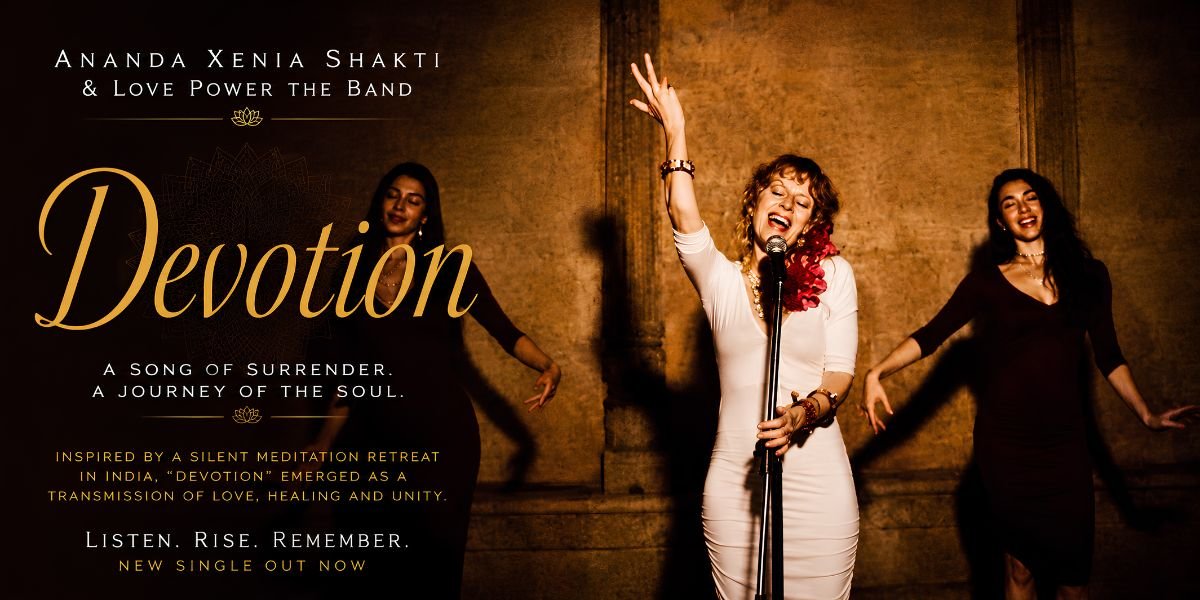
Ananda Xenia Shakti has never followed the predictable route. From her beginnings amid the kinetic energy of the late-1970s punk movement to a decades-long spiritual journey that eventually carried her to India, the singer-songwriter has built a career around transformation. On her latest single with Love Power the Band, “Devotion,” all those seemingly disparate chapters converge in a recording that trades conventional pop urgency for something increasingly scarce: stillness.
“Devotion” was born not in a traditional songwriting session but during a silent meditation retreat in Andhra Pradesh, India. After waking during the night with physical discomfort, Ananda began quietly singing the names of Radha and Krishna to soothe herself. A melody emerged around the Hare Krishna Maha Mantra, and what began as an attempt to find comfort became an extended experience of creativity, contemplation and surrender.
That origin story isn’t merely promotional context. It’s embedded in the DNA of the recording.
Rather than rushing toward a hook, “Devotion” unfolds patiently, blending sacred chant with ambient textures and world-music influences. Love Power the Band creates an arrangement that feels spacious without becoming empty, leaving room for Ananda’s voice to function as both melodic centerpiece and meditative guide. The production understands that this isn’t a song requiring fireworks. Its power comes from repetition, atmosphere and gradual immersion.
Ananda delivers the vocal with a striking lack of theatricality. There are no gratuitous runs or dramatic attempts to convince listeners of the song’s spirituality. She simply inhabits it. Her voice carries an intimacy suggesting that the listener has wandered into a private moment of prayer and been invited to remain.
It’s a quality that separates “Devotion” from the considerable amount of contemporary music that borrows the aesthetics of mindfulness. Here, spirituality isn’t decoration. It is the reason the recording exists.
That authenticity makes more sense when viewed against Ananda’s unconventional career.
Long before Love Power the Band, she was known as Xenia Holliday and became part of the pioneering all-female punk group The B-Girls. The band emerged from the combustible late-’70s scene, and Ananda’s early career included touring with The Clash during the London Calling era and contributing background vocals to Blondie’s AutoAmerican.
On paper, punk clubs and meditation retreats might appear to occupy opposite ends of the cultural universe. In Ananda’s story, however, they’re connected by the same pursuit: freedom.
The B-Girls represented freedom from musical convention. Her spiritual work seeks freedom from another kind of limitation, conditioning, fear and the internal noise that prevents people from experiencing themselves fully. The amplification has changed; the impulse hasn’t.
That journey has also produced tangible commercial success. Ananda and Love Power the Band have scored multiple appearances on the UK iTunes charts, demonstrating that spiritually focused music can find an audience beyond meditation rooms and specialized playlists. Her visual work has similarly attracted recognition through awards at international film festivals.
“Devotion” feels particularly suited to that crossover space.
Its devotional foundation places it naturally alongside New Age, mantra and meditation music, but there’s enough melodic accessibility to reach listeners who might never identify themselves with those categories. The track could comfortably live on wellness and spiritual playlists while also appealing to audiences interested in ambient pop, global sounds and alternative forms of singer-songwriter music.
The accompanying video strengthens that identity. Drawing upon imagery associated with India, nature and spiritual practice, it extends the recording’s contemplative atmosphere rather than turning the song into a conventional performance clip. The result feels like one continuous statement across sound and image.
Most compelling, though, is the central paradox behind the composition. “Devotion” emerged from physical discomfort, yet the music communicates tranquility. Ananda has described the experience as discovering expansion within contraction, the possibility that difficulty itself can become an opening rather than merely something to escape.
It’s a philosophy that could easily become sentimental in less capable hands. Instead, the song largely avoids telling listeners what they should believe. The experience comes first.
And that’s ultimately where “Devotion” succeeds.
In a streaming economy engineered around instant hooks, short attention spans and increasingly aggressive competition for listeners, Ananda Xenia Shakti and Love Power the Band make the counterintuitive decision not to compete. They create space.
The song doesn’t shout for attention.
It waits for the listener to become quiet enough to hear it.
With its hypnotic devotional foundation, atmospheric production and compelling backstory, “Devotion” positions Ananda Xenia Shakti & Love Power the Band as distinctive voices in the expanding space where New Age, world music, spirituality and contemporary pop intersect. More than a meditation track, it’s an intimate musical document of transformation, and proof that sometimes surrender can make as powerful a hook as any chorus.