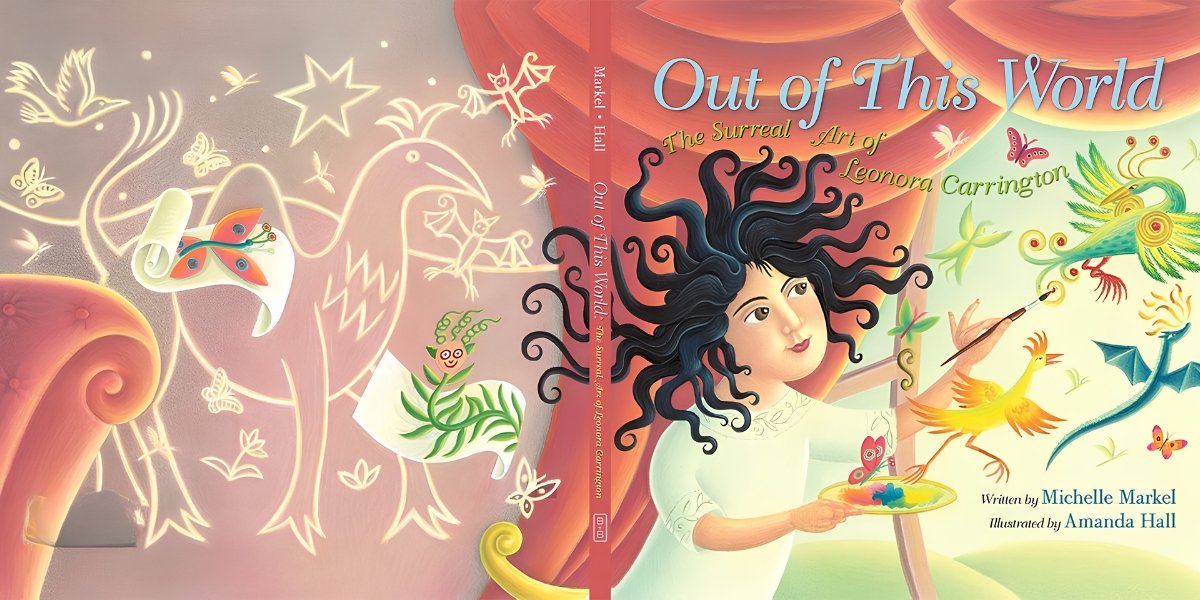

Illustration © Amanda Hall. From Out of This World: The Surreal Art of Leonora Carrington, written by Michelle Markel. Published by Balzer & Bray / an imprint of HarperCollins Publishers.
The process of creating a children’s book entails numerous collaborative relationships in which the writer’s participation is just one piece of a much larger puzzle. The use of illustration, for example, is an important part of a book’s narrative strategy and requires collaboration among several individuals: illustrators, writers, and even publishers. It should be acknowledged that there exist several models of collaboration in such a context, including publisher-based assignments as well as those created independently by authors and illustrators.
Amanda Hall, a British illustrator and author, has engaged in a range of professional collaborations throughout her career. Her early-stage project development often involved speculative partnerships with authors before submitting to publishers. These projects include work with Michelle Markel on Out of This World: The Surreal Art of Leonora Carrington, with Jamila Gavin on Tales from India, and with Dawn Casey on Babushka and Little Bear. Such collaborations were structured through provisional working agreements between Hall and the authors, which outlined shared authorship, creative responsibilities, and preliminary intellectual property considerations while the project was being developed. These arrangements existed before formal contracts with publishers were established, allowing for the negotiation of rights, format, and content in advance.
Collaborations on speculative projects require agreement on both the narrative and visual direction, as well as on the overall framework of the project during its development. This differs from commissioned projects, where the publisher has greater control over content and design. In the children’s publishing industry, pre-submission collaboration between authors and illustrators remains relatively uncommon, as editors generally prefer to pair illustrators with completed manuscripts.
In speculative collaborations of this kind, licensing rights are not formally apportioned at the development stage, whereas publishing contracts define the allocation of rights, including reproduction, adaptation, and merchandising. When parity and mutual respect exist between collaborators, this approach can support creative independence, though it also carries the risk that the project may not secure a publishing contract.
The contractual agreements contain provisions for various aspects, including reproduction rights, adaptation rights, and merchandising rights. In projects developed speculatively, these elements are often discussed and provisionally agreed upon between collaborators before submission. By contrast, in Hall’s work with authors such as Jennifer Berne and Shoshana Boyd Gelfand, collaboration began after the text had been completed and the authors were already under contract. In these cases, Hall’s involvement followed a standard commissioning process, with her contracts drawn up by the publisher in line with established publishing practices.
The distinction between speculative and commissioned collaborations also extends to the creative process, though not in a uniform way. In collaborative projects, Hall has been involved with the author from an early stage in shaping the concept for the book, often over extended periods without financial compensation. Rather than working in a tightly coordinated or continuous exchange, collaborators typically establish a shared understanding of the project through early discussion, after which the writer and illustrator proceed with a degree of autonomy. Further dialogue may take place as needed, within a framework of mutual respect. This approach can vary between projects, as each collaboration develops its own working method.
An additional factor is the role of choice. In pre-submission collaborations, both parties actively select one another as creative partners, which can influence the direction and cohesion of the work. This differs from the standard publishing model, where authors are often assigned illustrators after a manuscript has been contracted, with limited input into that decision. Illustrators, by contrast, retain the option to accept or decline a commission. Within publisher-led projects, the creative process is shaped by editorial direction, although the extent of artistic freedom granted to the illustrator may vary depending on the publisher and the nature of the book.
Another area where public engagement can be seen is through collaboration. Hall appeared in 2011 at the Cheltenham Literature Festival alongside Jamila Gavin, during which they discussed their collaborative work ‘Tales From India’.
Hall’s career demonstrates two professional models within picture book publishing: publisher-led commissions and author-illustrator-initiated development. The former relies on editorial direction and pre-existing market frameworks, while the latter involves creative collaboration before formal submission. Both models require attention to contractual detail and rights management, with implications for intellectual property, merchandising, and subsequent licensing opportunities. Hall’s work exemplifies how these approaches operate in practice, providing a case study for navigating professional relationships in children’s literature.
The author-illustrator approach is exemplified in Hall’s solo works, such as Song of the Raven (2002, originally published as The Stolen Sun by Frances Lincoln and republished in 2024 by Wisdom Tales in the US) and Prince of the Birds (2005, Frances Lincoln). These titles highlight the potential for a unified conceptual framework, in which the narrative and visual components are integrated from the outset. Even within collaborative projects, Hall’s visual identity maintains a consistent approach, emphasizing densely layered compositions, attention to detail, and a spatial awareness that enriches the text.
Long-term professional relationships with publishers in both the UK and the US have provided context for Hall’s collaborative practices. Some examples of British publishers with which she has worked are Lion Children’s Books, Frances Lincoln, Dorling Kindersley, Barefoot Books, Pavilion Books, and Templar Publishing. In the United States, she has worked with Eerdmans Books for Young Readers, Wisdom Tales, and Balzer and Bray. This is an example of why it is important to have clearly defined rights for illustrations as well as merchandising rights when transitioning from speculative partnerships to a publishing contract.
Hall’s experiences provide insight into the potentialities and constraints associated with both co-authorships before submission and illustration after commissioning, revealing the diverse professional approaches taken by illustrators in today’s children’s book publishing world.
Amanda Hall’s career, through both her collaborations and independent work, demonstrates the relationship among the freedom of creativity, contractual arrangements, and professional practice, serving as a concrete case study of the many ways picture books can be created and marketed.