
By Julian Kane
There is a particular kind of confidence required to make music that doesn’t announce its complexity. On “We Are,” Eddy Mann accomplishes something considerably more interesting than simply writing a Christian worship song in an unusual time signature. He makes the unusual feel inevitable.
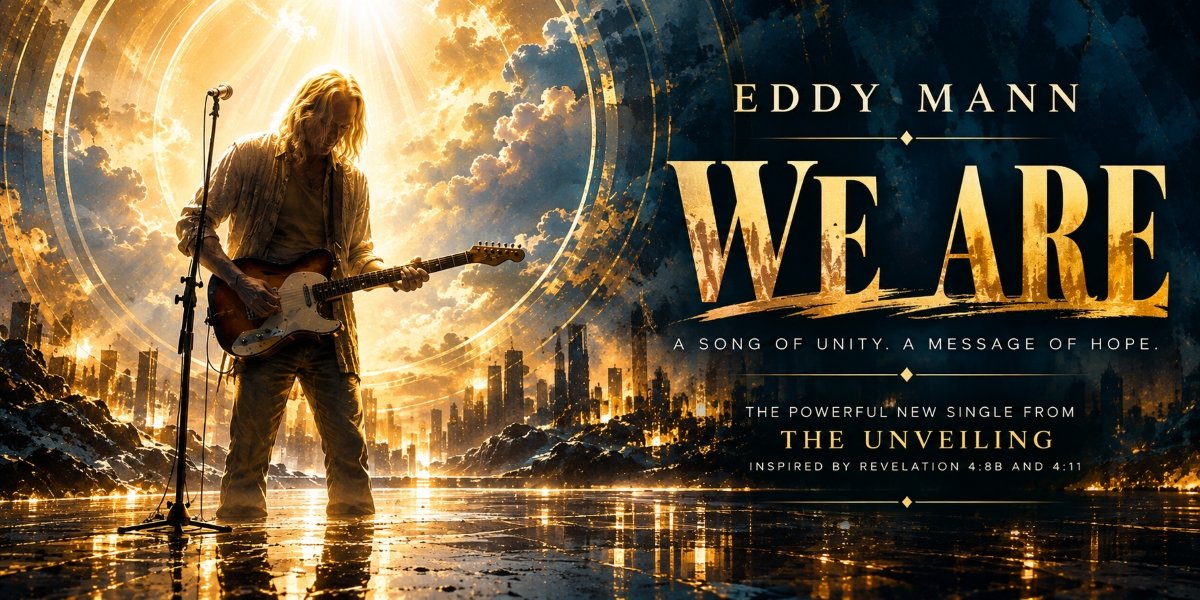
Drawn from his album The Unveiling, “We Are” takes its inspiration from Revelation 4:8b and 4:11, passages centered on the holiness and worthiness of God. Mann translates those verses into a jazz-influenced meditation that inhabits the territory between contemporary worship, sacred jazz and the intimate singer-songwriter tradition he has cultivated across decades of music and ministry.
The track’s defining musical characteristic is its 5/4 meter. Yet Mann has explained that the rhythm wasn’t an intellectual exercise or deliberate attempt to distinguish himself from conventional worship music. The song emerged during a quiet devotional moment and simply settled into five.
That distinction can be heard.
“We Are” doesn’t behave like a composition eager to demonstrate that it knows an odd meter. Instead, the rhythm produces a gentle forward motion, an extra breath in each measure that subtly unsettles expectations without disturbing the song’s contemplative atmosphere.
It’s sophisticated without insisting upon its sophistication.
That quality suits Mann.
After more than three decades as a songwriter, musician, worship leader and minister, he has reached a stage where artistic choices sound less like decisions calculated for an audience and more like natural extensions of who he has become.
Mann has described God as his “audience of One.” “We Are” sounds remarkably faithful to that philosophy.
The lyric opens with one of Christianity’s most enduring declarations: “Holy, holy, holy.” Mann then acknowledges God across time, the One who was, who is and who remains to come, before arriving at the passage around which the entire song turns:
“We are Your will
We are Your desire
We are Your pleasure.”
The language is strikingly economical.
There are no complicated metaphors to decode and no theological arguments demanding resolution. Mann instead places three statements before the listener and allows repetition to deepen their meaning.
The most important word may be the smallest.
We.
Mann could have constructed the song around individual identity. Instead, he emphasizes collective purpose. It’s consistent with his longstanding belief in brotherhood and sisterhood and his concern that contemporary rhetoric too frequently encourages separation.
That perspective gives “We Are” resonance beyond explicitly Christian listening spaces.
The song doesn’t ignore individuality; musically, it celebrates it. Jazz has always depended upon recognizable individual voices operating within a collective. The musician must listen as intently as he plays. Personality matters, but so does responsiveness.
It’s difficult to imagine a more appropriate musical vocabulary for Mann’s message.
Unity, in this context, isn’t conformity.
It’s relationship.
That distinction becomes particularly meaningful within The Unveiling. The Book of Revelation has supplied centuries of frightening imagery to theology and popular culture alike. Its beasts, judgments and visions have inspired everything from sermons to novels to heavy metal.
Mann approached the same text and discovered something unexpectedly reassuring.
Rather than constructing The Unveiling around fear, he emphasizes perseverance, restoration, compassion and hope. “I Will Never Know the Desert Again,” another centerpiece from the project, imagines the end of physical, emotional and spiritual suffering. “We Are” considers another kind of restoration: the recognition that human beings share a fundamental identity as creation.
The restraint of Mann’s performance strengthens that idea.
There is no attempt to manufacture a spiritual experience through sheer production scale. “We Are” doesn’t require the enormous crescendo familiar from contemporary arena worship. Its power comes through space, phrasing and repetition.
Mann’s vocal carries the weathering of experience. He doesn’t sound like someone discovering these ideas for the first time. Nor does he sound like someone attempting to convince the listener through force.
He sounds settled.
That’s different from complacency.
In fact, one of the pleasures of Mann’s recent work is hearing an established artist remain musically curious. It would be considerably easier, after decades of recording, to rely upon familiar forms. Instead, Mann allows a devotional encounter to lead him toward sacred jazz and an asymmetric meter.
There’s something spiritually appropriate about that willingness.
Faith, at its most interesting, doesn’t always confirm what someone already expects to find.
Neither does music.
By the time “We Are” reaches its concluding affirmation of God’s worthiness, the song has traveled an intriguing distance despite using relatively few words. It begins with God’s nature, moves toward humanity’s purpose and returns to worship.
The circle closes.
But that fifth beat remains.
It gives the music just enough imbalance to remind the listener that certainty and predictability aren’t necessarily the same thing.
For Eddy Mann, “We Are” represents a quietly compelling convergence of his identities as musician, songwriter and minister. Scripture supplies the foundation. Jazz provides the freedom. Experience supplies the restraint.
And one deceptively simple pronoun supplies the message.
In a culture extraordinarily proficient at defining people by what separates them, Mann offers an alternative.
Not me.
Not them.
We.
Sometimes the most profound musical statements don’t require more words.
They simply require finding the right rhythm for the ones that matter.