
By Reid Ashcroft
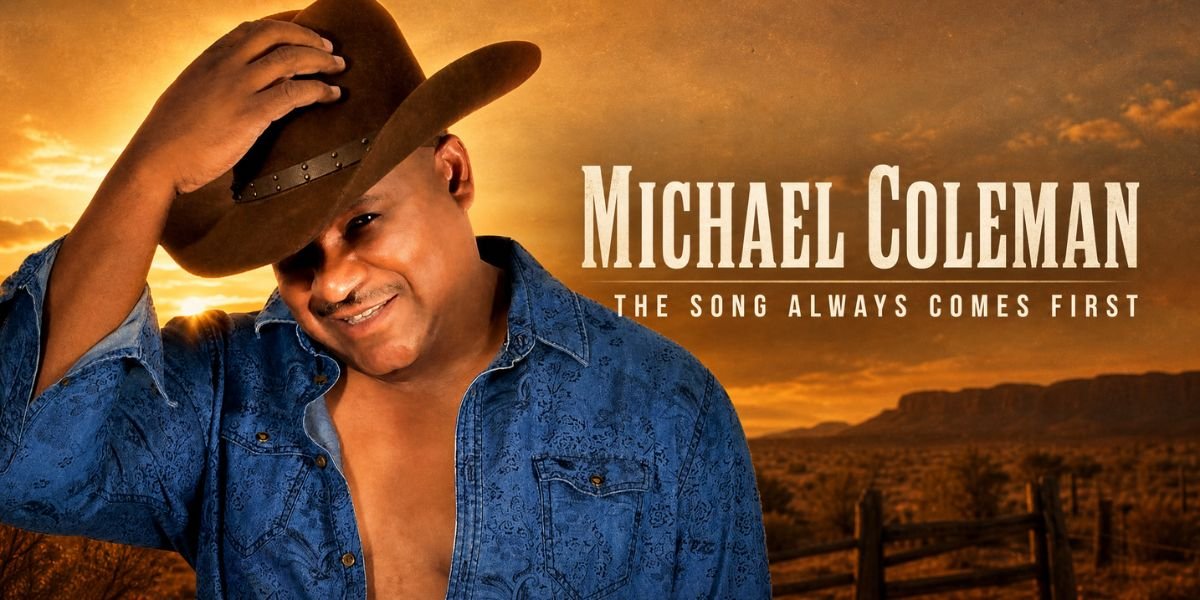
For more than a decade, Michael Coleman has quietly built a distinctive creative project in independent country music. Under the banner of See Your Shadow, he has accumulated a run of chart-topping singles, national awards, and critical acclaim, not by chasing radio trends or industry formulas, but by trusting the timeless power of honest storytelling.
While many artists build careers around a recognizable face or personality, Coleman intentionally moved in the opposite direction. The See Your Shadow logo has become the identity, allowing each song to stand on its own merits while a rotating “Network of Stars” of musicians and vocalists breathe life into the material. It’s an unconventional philosophy in a business often driven by image, but it reflects Coleman’s unwavering belief that songs, not celebrity, should remain the center of attention.
That belief begins with the writing process itself.
“I just go where the inspiration takes me,” Coleman explains. “Sometimes the melody comes first, sometimes it’s the idea of what I want to write about. I genuinely never know how a piece is coming to life.”
Even after decades as a songwriter, he resists forcing a formula onto his work. Some songs evolve exactly as expected. Others surprise him completely. He points to both the breakout hit “I Will Tell Jesus You Said Hello” and his latest single, “Another Saturday,” as examples of songs that ultimately found destinations he never anticipated when they began.
That willingness to follow inspiration wherever it leads gives “Another Saturday” its emotional authenticity.
Although the song feels immediate, its origins stretch back nearly thirty years. Originally written as a poem during a deeply personal period following the end of a relationship, the piece remained tucked away until Coleman realized it still carried the same emotional weight decades later.
Looking back now, he recognizes just how autobiographical the song truly was.
“I probably was that woman,” he admits.
The loneliness, uncertainty, and quiet search for identity portrayed in the song weren’t fictional observations. They reflected where he actually was emotionally at the time. Choosing to release it now, after previously believing he was finished recording new music altogether, became both an artistic and personal statement.
“I knew that the next piece had to be strong,” Coleman says. “Another Saturday still made me feel those emotions, and I knew if it affected me that way, others would respond to it too.”
That emotional connection has become the defining characteristic of the See Your Shadow catalog.
Rather than building a traditional band, Coleman developed what he calls his “Network of Stars,” assembling different collaborators whose unique voices best serve each individual composition. The idea grew from frustration with an industry that often placed appearance, age, and personality ahead of songwriting.
“The superficiality of show business was having the work get lost,” he recalls. “People were more concerned with how performers looked than the songs themselves.”
By removing that emphasis and presenting releases simply under the See Your Shadow name, Coleman believes listeners approach the music with fewer preconceived expectations. His collaborators become storytellers rather than celebrities, contributing genuine emotional investment instead of simply performing assigned material.
“The stars shine just as bright when they’re young as when they age,” he says. “They bring their full selves to the material.”
The results speak for themselves. Eight chart-topping singles and multiple national honors have established See Your Shadow as a consistently successful project in independent country music.
Yet awards and chart positions aren’t what convinced Coleman his music truly mattered.
That realization came through a message from a mother.
After hearing See Your Shadow’s Christmas song, “Christmas on Cellblock 9,” she wrote that her son, who is autistic, connected with the music in a way that surprised her. The song brought him visible joy.
“That’s when I truly knew what we were doing mattered,” Coleman says.
It’s the kind of response no chart statistic can measure.
Perhaps that’s because Coleman’s songs consistently explore experiences nearly everyone understands: faith, grief, perseverance, redemption, loneliness, and hope.
“I always say I write about the human experience,” he explains. “As long as we’re on this planet, those are issues we’ll be dealing with.”
He also believes audiences today are becoming more comfortable acknowledging emotional vulnerability.
“I think people are getting less and less afraid to say they’re not OK.”
Outside the recording studio, Coleman encounters countless real-life stories through his role as owner of Phoenix’s Nu Towne Saloon. The hospitality business continually introduces him to people from every walk of life, providing fresh perspectives that naturally find their way into his songwriting.
“Nu Towne allows me to encounter so many different people,” he says. “It continues to expose me to the human elements on which I write.”
Whether through a song or a welcoming venue, his goal remains remarkably similar: creating spaces where people feel understood and connected.
Commercial country music often favors polished production and predictable themes. Coleman hopes listeners discover something deeper in See Your Shadow’s music.
“I hope people realize they’ve been duped by large corporations into telling them what good music is,” he says. “Music is an experience for the mind and the ears as well as the soul.”
That philosophy has guided every chapter of See Your Shadow’s journey, and it shows no signs of changing.
In fact, Coleman already has his sights set on an even more ambitious challenge.
With a smile, he reveals the idea that’s been quietly waiting in the wings for years.
“Maybe it’s finally time to write that country and western opera I’ve been wanting to do.”
For an artist who has spent decades proving that great songs can emerge from unexpected places, it doesn’t sound impossible at all.