
By: Olga Amraie
The founder of Miss Silicone USA explains the production rules he used to turn a beauty pageant into a full Hollywood revue, and how he is applying them to a bigger night in Miami.
Every event producer knows the moment. The music stops, someone walks to a microphone, a list of names is read, and you can watch the audience reach for their phones. Energy that took an hour to build disappears in ninety seconds.
Andy Star calls those moments “dead minutes,” and he has built his producing philosophy around eliminating them.
“People don’t come out on a Saturday night to watch a checklist,” says Star, founder, owner and producer of Miss Silicone USA. “They come to feel something. My job as a producer is to make every minute of the evening part of the show.”
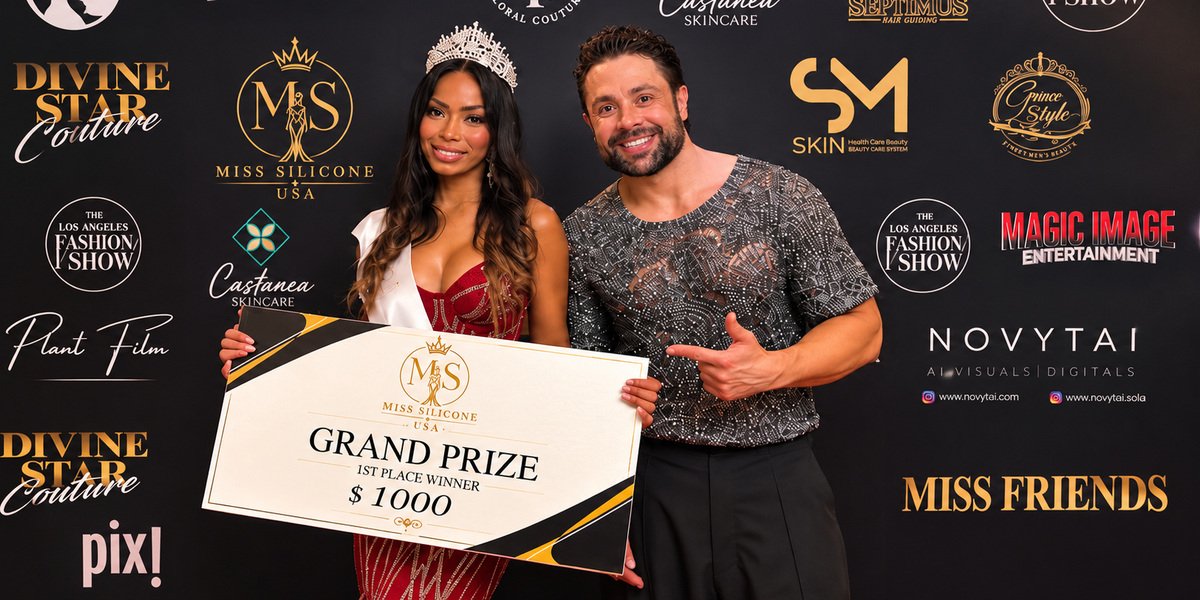
Star is also a singer and stage performer known from Season 20 of America’s Got Talent, which gives him an unusual vantage point. He has spent years on the other side of the curtain, watching what keeps a crowd in its seats and what sends it to the bar. When he launched Miss Silicone Los Angeles 2026 on September 26 at White Rabbit Sky Lounge in West Hollywood, he kept the traditional crown and rebuilt everything around it.
Here are the production principles he used, in his own words.
Rule one: build a revue, not a ceremony
Most pageants follow a familiar script: walk, pose, answer, crown. Star approached the evening the way a theater producer builds a stage revue, where every segment has a rhythm, a purpose and a payoff.
“A ceremony is a list of things that must happen,” he says. “A show is a story with an arc. I map the whole night on paper like a setlist: where the energy rises, where it rests, where the surprise lands. If a segment doesn’t move the story forward, it gets shorter or it goes.”
On the night, the program moved from red carpet arrivals to eveningwear and swimsuit rounds, on-stage questions and judging, with live performances woven between them so the momentum never dropped.
Rule two: fill the transitions
The gaps between segments are where most events lose their audience. Star’s answer was to make the transitions themselves part of the entertainment. Host Septimius the Great kept the pace. DJs Katy Q and Camille Brown held the floor. Violinist Shynaran and saxophonist Erisa Nicole played live, and guest vocalist Linn Holmstedt added her voice. Divine Star Couture presented a dance fashion show, turning musical numbers into visual moments.
“The audience should never see the machinery,” Star says. “While the stage resets, something beautiful is happening somewhere else. That’s not decoration. That’s how you protect the energy you worked to build.”
Rule three: the producer should understand the stage from the inside
Star did not stay backstage. He opened and closed the show himself, premiering four original songs in his signature blend of swing, pop, retro and retro-pop.
He is quick to say this is not about ego. “Performing teaches you timing in a way no spreadsheet can,” he explains. “When you’ve stood under the lights and felt a room go quiet, you produce differently. You know exactly how long a speech can run before you lose people.”
That performer’s instinct, honed as The Singing Skater, who delivers live vocals on roller skates, shapes his decisions: bold looks, humor and a show that never stands still.
Rule four: borrow an audience, then earn it
The Los Angeles pageant took place inside The Hollywood Mixer, an entertainment and networking event co-produced by Andy Star and Olga Amray. The format brought a ready-made audience of creatives, entrepreneurs and industry guests.
“A first-time event doesn’t have to start from zero,” Star says. “Partner with a format that already has a crowd. Then give that crowd a reason to come back for you specifically.”
International producer and choreographer Mario Mitkov attended the premiere as an invited guest and joined the judging panel as a guest judge, adding an international perspective on stage presence and live entertainment.
Rule five: the message is part of the production
Six contestants competed for the first Los Angeles title, and Rosalyn Clarin, a pre-operative nurse, model and single mother, was crowned Miss Silicone Los Angeles 2026. The pageant runs under the message BEYOND STANDARDS, celebrating confidence, individuality and stage presence over one narrow ideal of beauty.
“An audience can forgive a technical glitch,” Star says. “What it won’t forgive is a show with nothing to say. Decide what your event stands for before you decide the lighting.”
Scaling the formula: Miami as a production design challenge
Star is now applying the same rules to a larger canvas. Miss Silicone Miami 2026 takes place on December 19, 2026, and is planned as a premium luxury evening.
For a producer, the most interesting part of the Miami night is arguably the red carpet itself. Rather than a backdrop and a step-and-repeat, guests will arrive through a curated lineup of exotic supercars and rare collector cars. Ferrari and Lamborghini models will be on display, and Club Shelby Cobra Owners Florida is supporting the evening together with Miami collector Antonio Adili, owner of Auto Café in North Miami Beach, who will bring legendary Shelby Cobras to the lineup.
“Cars are set design that people actually want to photograph,” Star says. “Modern Italian supercars next to classic American Cobras tells the same story my music tells: classic glamour that still feels new. It sets the tone before anyone reaches the stage.”
Bloggers, influencers, media and VIP guests are expected, along with fashion, live entertainment, the competition and a new performance by Star. The venue will be announced soon.
The takeaway for anyone producing live events
Asked to sum up his approach for other producers, Star keeps it short: “Know your arc. Kill the dead minutes. Stand on the stage yourself at least once. And never confuse a schedule with a show.”
Miami is only the next step. Miss Silicone USA plans to bring its competition to every state, with Andy Star producing every stage.
More information: misssiliconeusa.com.