
By Ted McAllister
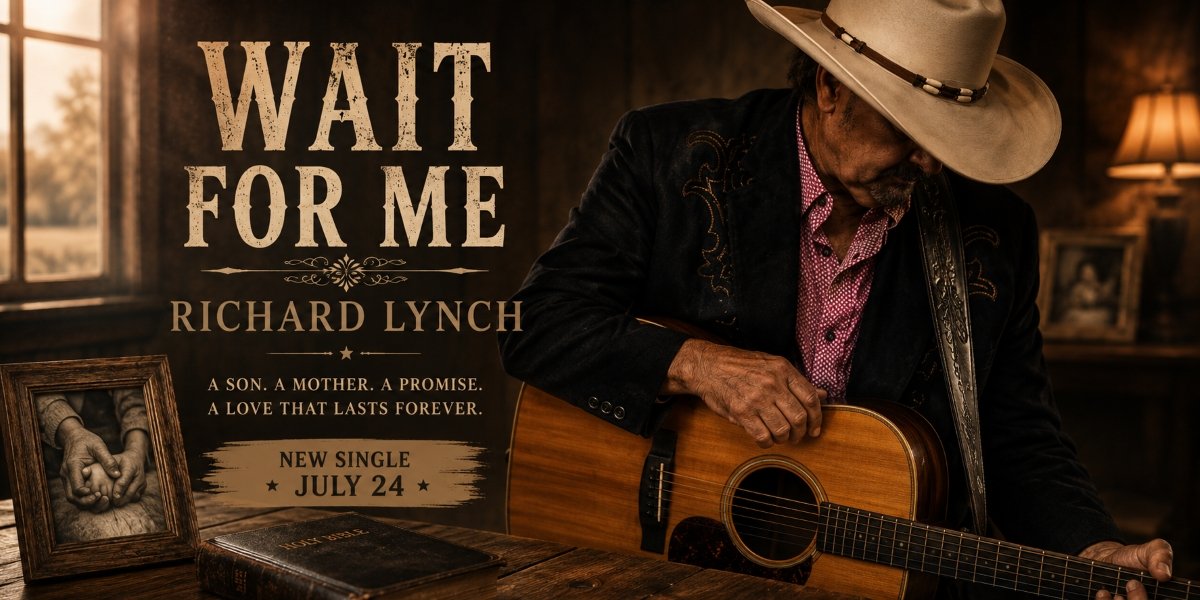
There’s a moment in Richard Lynch’s “Wait For Me” when a country song about death quietly reveals itself to be a song about work. Not jobs or paychecks, but the mostly invisible work of loving somebody for a lifetime: wiping tears, mending clothes, soothing pain, making the impossible seem manageable. Lynch finds all of that history in his mother’s hands.
And suddenly a farewell becomes something much bigger.
“Wait For Me,” co-written by Lynch and John Lee, is an unabashedly traditional country ballad about a son learning that his mother is nearing the end of her life. The phone call has come. She’s made peace. She’s “ready to leave with God.” He has only one request: hold on until he gets there.
“Momma, I’m on my way,” Lynch sings. “Hold on, wait for me.”
There’s nothing complicated about the setup, and that’s precisely why it works. Lynch doesn’t bury the moment beneath metaphor or manufacture some movie-ready tragedy around it. He takes one of adulthood’s most dreaded experiences, realizing that the parent who once seemed indestructible has become fragile, and tells it plainly.
That plainness is increasingly Lynch’s superpower.
For years, the Ohio singer has planted himself on the traditional side of country music, maintaining an allegiance to straightforward narratives, recognizable instrumentation and the notion that singers should sound like they’ve actually lived long enough to understand the stories they’re telling. On “Wait For Me,” those instincts converge around subject matter perfectly suited to his weathered baritone.
Lynch doesn’t oversing. He doesn’t need to.
The first verse finds him visiting his mother while she sleeps. He sits beside her, holds her hands and begins to cry. But he makes an important distinction: these aren’t simply tears of grief. They’re tears of “thankfulness and joy.” Holding those aging hands sends him backward through time until the grown man beside the bed is remembering the little boy those same hands once comforted.
It’s a deceptively effective songwriting device.
Soon, the hands become a biography. They wiped away tears. They soothed pain. They stitched clothes. They moved mountains.
That last phrase might sound like conventional country sentiment on paper, but Lynch and Lee earn it by surrounding it with mundane details. These weren’t metaphorical hands until years of ordinary sacrifice turned them into something symbolic. That’s the point. A parent’s legacy isn’t necessarily found in grand achievements. Sometimes it’s sitting in a drawer full of repaired shirts or buried inside childhood memories of being comforted when the world felt frightening.
“Wait For Me” understands that love is often a verb long before anyone bothers turning it into a song.
The production follows the lyric’s lead. Rather than inflate the material into an oversized power ballad, the arrangement gives Lynch room to tell the story. It has the feel of country music made for listening rather than scrolling, patient, uncluttered and confident enough to believe an audience will stay if the story deserves its attention.
In 2026, that almost qualifies as a radical proposition.
Mainstream music is increasingly engineered around immediacy. Songs are asked to deliver their payoff before the listener has time to reach for a phone. “Wait For Me” operates according to an older contract: Lynch will tell you the story, and you’ll give him enough time to finish it.
The reward comes late.
After considering everything his mother’s hands have done for others, Lynch wonders whether they’re tired now, whether they ache from a lifetime spent serving everyone else. Then comes the thought that gives the song its emotional center: maybe, during their final time together, he was able to return some small measure of the comfort she had given him.
That’s when “Wait For Me” stops being merely sad.
It becomes grateful.
Faith is woven just as naturally into the song. Lynch’s mother is prepared to “leave with God” because she has “always believed.” The language doesn’t arrive like a sermon or a demographic calculation. It simply reflects the worldview of the people inside the story. Heaven is not used to erase grief; belief gives the characters a way to move through it.
And Lynch allows grief to remain grief.
The final lines deliver the resolution: her pain is gone. She can rest. Most importantly, she saw what he desperately needed her to see.
“You held on / You waited for me.”
It’s a devastatingly simple ending because it resolves the tension established by the title. The son made it. The mother waited. The words that might have gone unsaid were spoken.
That makes “Wait For Me” less a song about dying than one about showing up.
Country music has been exploring that territory since long before anybody started dividing the genre into traditional, mainstream, Americana or whatever new category arrives next. Its strongest songs have always understood that enormous emotional stakes can hide inside ordinary rooms: a kitchen after midnight, an empty bedroom, a front porch, a hospital bedside.
Richard Lynch doesn’t reinvent that tradition here. He doesn’t have to.
Instead, “Wait For Me” demonstrates why it survives. Parents grow older. Children become caretakers. Strong hands weaken. People who once seemed permanent suddenly aren’t. No production trend is going to make those truths obsolete.
The most powerful thing about Lynch’s single may be what it asks listeners to do after it ends. Call somebody. Visit somebody. Say the thing you’ve assumed there would always be time to say.
Because someday, there won’t be.
“Wait For Me” is old-school country storytelling without apology: direct, vulnerable, faithful and more interested in emotional truth than fashionable cool. Lynch delivers it like a man who knows exactly what those words cost.
Sometimes three chords and the truth still work.
Sometimes they’re all you need.