
By: Rachel Monroe
At a moment when musicians are told to think about algorithms, content schedules, streaming numbers and viral moments, CattSue is interested in something considerably less complicated: whether a song makes another human being feel understood.
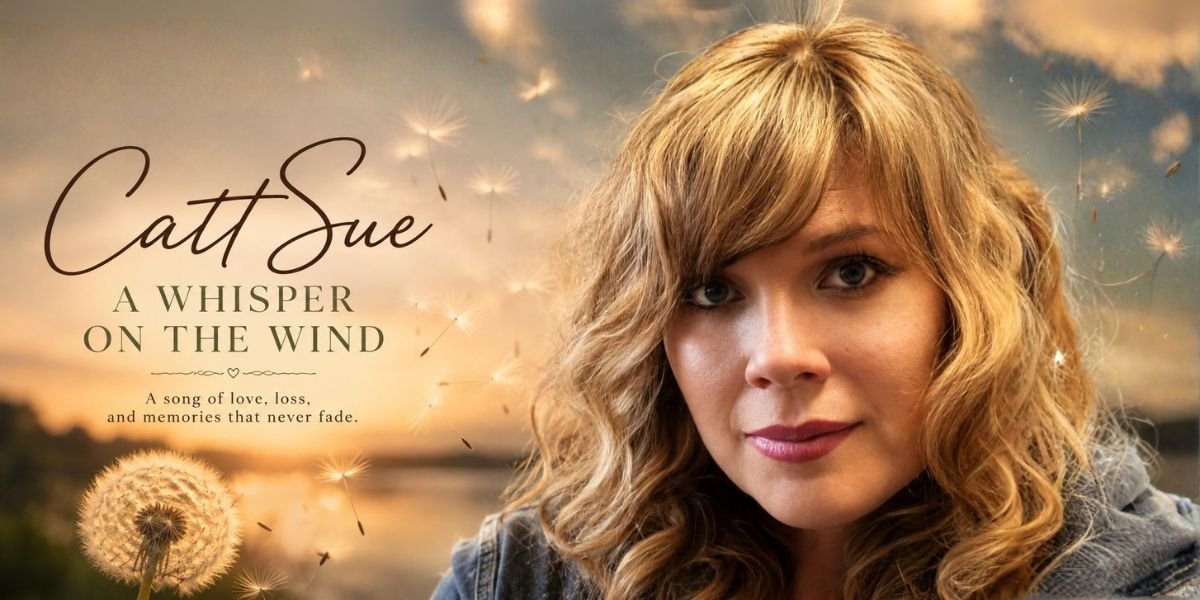
The Jacksonville-based singer-songwriter has built her emerging career around deeply personal storytelling, drawing from family, loss, love, addiction, heartbreak and resilience. Her single, “A Whisper on the Wind,” may be the clearest expression yet of that philosophy. Inspired by losing her mother when she was very young, the song turns an intensely private experience into an invitation for listeners to consider their own relationships with grief and memory.
“There is a piece of my own childhood and my own grief woven into every part of that song,” CattSue says. “But I never wanted it to belong only to me.”
That distinction is important. Rather than treating grief as something to overcome on a convenient schedule, CattSue sees it as part of an ongoing relationship with those who are gone.
“Grief doesn’t have a timetable, and loving someone doesn’t end because they are no longer physically here,” she says. “Sometimes a memory, a song, a smell, or even the wind can bring somebody right back into your heart for a moment.”
It is a decidedly patient philosophy for an impatient cultural moment.
Popular music now exists in an environment where artists compete not only with other songs but with an endless stream of posts, videos, headlines, and distractions. CattSue believes that environment may actually be creating a renewed appetite for songs that ask listeners to slow down.
“We live in a world where everything is moving so fast,” she says. “But human emotions haven’t sped up. We still love deeply. We still lose people. We still miss people, fall apart, heal, and remember.”
For her, a song’s ability to create three or four minutes of emotional stillness can be more meaningful than its ability to generate a fleeting online reaction. “A song doesn’t have to shout to be powerful,” she says. “Sometimes the songs that stay with us the longest are the ones that quietly find a place inside us.”
CattSue is pursuing that connection as an independent artist, a path offering unprecedented freedom alongside a formidable workload. Without the infrastructure of a traditional major label, she has discovered that making music is only one part of the job.
“You have to become much more than the artist,” she explains. “You’re learning the business, promotion, radio, distribution, branding, relationships, and how to advocate for yourself.”
Digital platforms have made reaching a national or international audience possible without waiting for an industry gatekeeper. The tradeoff is extraordinary competition.
“Talent matters, but persistence, relationships, professionalism, and understanding the business matter too,” she says.
That same tension exists on social media. Artists are increasingly expected to function as perpetual content creators, feeding audiences and platforms a steady supply of material. CattSue participates, but she has established a boundary.
“I remind myself that I became a songwriter to tell stories, not to feed an algorithm,” she says.
For CattSue, authenticity remains the test. Technology can help distribute the story. It shouldn’t become the reason the story exists.
That perspective extends to artificial intelligence and the rapidly evolving technology surrounding music creation. CattSue isn’t opposed to new tools and sees substantial opportunities for independent musicians to use technology for organization, promotion, workflow, and audience discovery.
But she draws a clear distinction between assisting creativity and supplying its emotional source.
“Technology cannot live your life for you,” she says. “It cannot lose your mother when you are a little girl. It cannot know what it feels like to miss someone twenty or forty years later.”
Those experiences, she says, remain the heartbeat of her songwriting.
Her approach also reflects an era when genre boundaries are becoming increasingly porous. Country, Americana, roots music and the singer-songwriter tradition may provide CattSue’s foundation, but she isn’t particularly interested in allowing a category to dictate where she goes next.
“I think genre still helps people understand where a song lives musically, but I don’t believe it should become a cage,” she says. “I’m far more interested in whether someone feels the song than whether we can perfectly label it.”
Her geographic identity is similarly layered. Though Jacksonville is home today and central to her professional and creative life, CattSue grew up in West Deptford, New Jersey. She credits New Jersey with giving her earliest memories, family stories, and toughness, while Jacksonville represents another chapter, one where she has built businesses, relationships, and her developing music career.
As her audience expands, she hopes to carry pieces of both places with her.
“Family matters, loyalty matters, hard work matters, and ordinary people have extraordinary stories,” CattSue says. “Those are the people I write for.”
That may ultimately be the simplest explanation for her music. In an industry increasingly capable of measuring almost everything, streams, views, followers, engagement, CattSue remains preoccupied with something much harder to quantify.
Connection.
“If the song makes someone feel a little less alone,” she says of “A Whisper on the Wind,” “then it has done what I hoped it would do.”
For an independent songwriter navigating a noisy digital world, that might be the most meaningful metric of all.