
By: Tessa Marlowe
The blues have always had a marketing problem. Everybody loves the mythology—the crossroads, the heartbreak, the smoky clubs, the weathered guitars. What gets lost is the simple fact that the best blues artists don’t perform authenticity. They possess it.
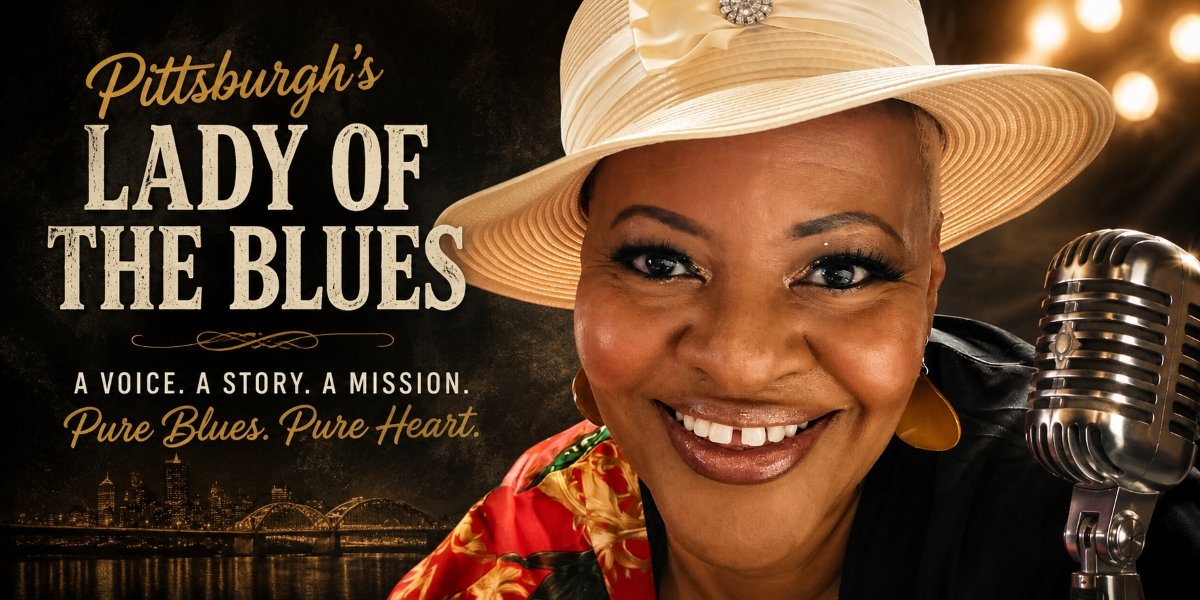
That’s why Miss Freddye matters.
For three decades, Pittsburgh’s “Lady of the Blues” has been making music that feels refreshingly free of pretense. No manufactured backstory. No borrowed persona. No attempt to cosplay her way into a tradition. Just a singer with a formidable voice, a complicated life behind it, and a deep understanding of what the blues is supposed to do: tell the truth.
Born and raised in Pittsburgh, Miss Freddye began singing in church before her mother’s love of blues pointed her toward another musical language. In 1996, she joined Blues Music Works under bandleader “Big” Al Leavitt, an early mentor whose belief in her helped push an initially apprehensive singer onto the stage. She formed Blue Faze in 2002 and eventually led both Miss Freddye’s Blues Band and the acoustic-minded Miss Freddye’s Homecookin’ Band.
It’s a career trajectory with practically none of the convenient mythology the music industry loves. Miss Freddye didn’t emerge from some hyped scene with an army of tastemakers declaring her important. She worked. She performed. She raised a family. She spent decades as a nurse, including work in surgical oncology, while simultaneously building her reputation on Western Pennsylvania stages.
It turns out that caring for people through some of the most frightening moments of their lives is pretty good preparation for singing the blues.
So is surviving.
Miss Freddye is herself a two-time cancer survivor. That fact isn’t necessary to validate her music, but it helps explain the extraordinary lack of distance between singer and song. When she sings about pain, perseverance, faith or loss, there’s no wink between the performer and the material. She’s been there.
Her instrument reflects that history. Miss Freddye can belt, testify, tease and turn unexpectedly tender. Her acknowledged influences read like a syllabus in emotional authority: Koko Taylor, Etta James, Sarah Vaughan, Billie Holiday, Big Mama Thornton and Bessie Smith. But imitation isn’t the point. Somewhere across thousands of performances, those influences were absorbed and transformed into something identifiable as the Miss Freddye sound.
Her 2017 album Lady of the Blues, recorded at Kid Andersen’s Greaseland Studios, put that sound into sharper focus. Blues Blast Magazine praised her ability to handle both uptempo material and ballads, while the record subsequently helped bring her national blues recognition.
Then came the kind of industry validation independent artists spend careers chasing. In 2018, she received Blues Foundation nominations connected to Best Emerging Artist Album and the Koko Taylor Award for Traditional Blues Female. Pittsburgh had already figured her out; now people beyond Pennsylvania were catching up.
Still, the trophies aren’t the interesting part.
The interesting part is what she believes the music is for.
Miss Freddye has described walking onto a stage knowing the performance isn’t really about her. Somewhere in the audience may be somebody who needs the song—someone carrying grief, exhaustion, loneliness, or trouble who gets three or four minutes of relief because another human being is willing to articulate what hurts.
That’s blues stripped to its essential function.
It also explains why gospel sits so naturally beside the secular blues in her catalog. Her recording of “Wade in the Water” brought her explicitly back toward the church music of her youth, but the distance between Saturday-night Miss Freddye and Sunday-morning Miss Freddye was never particularly wide. Blues describes the wound. Gospel insists it might heal.
Even her 2024 single “Slippin’ Away,” written by her late friend Mike Lyzenga, turned loss into something communal. Recorded in Pittsburgh with Mike Huston, Jeff Conner, Greg Sejko and Bob Dicola, it gave Miss Freddye another vehicle for what she does best: taking an emotion people would rather avoid and making them sit with it.
Her work outside music completes the picture. Over the years, she has supported cancer organizations, veterans, Toys for Tots, domestic-violence initiatives and other community causes. Again, there’s remarkably little separation between the person and the performer.
And now, after decades in the game, Miss Freddye sounds less interested in protecting a legacy than extending one. She’s talked about recording more, collaborating with songwriters and getting their music heard internationally. Most revealingly, she has summed up her artistic philosophy with a simple idea: “What I do is not mine to keep.”
That might be the best explanation of Miss Freddye’s career.
The blues aren’t hers to keep. Neither are the stories, the survival, the faith or the hard-earned wisdom.
She gives them away every time she opens her mouth.
That’s not retro. That’s not nostalgia.
That’s what the blues were invented for.