

By: Nic Abelian
At fifteen, elite, and entirely unwilling to pretend otherwise.
I found Nelly Opitz the wrong way. Someone had dropped her name in a group chat with a screenshot and a question that was half-joking, half-not: ” Is this real? The image was a still from what looked like a training video, clean form, precise movement, the kind of visual consistency you associate with a render rather than a person. I went to her Instagram expecting to feel certain one way or the other. I did not.
What I found instead was a fifteen-year-old in Germany who is, among other things, a competitive rope-skipping athlete, an emerging model, and a bilingual content creator with over 125,000 Instagram followers and 19,000 on TikTok. She is also in school. She has homework. She has the particular kind of life that happens when you are good at something very specific, interested in several other things simultaneously, and not yet old enough to have decided which one defines you.
That last part is the thing worth paying attention to.
The default way to write about a teenager doing multiple things at an unusually high level is to make it a story about precocity, the prodigy narrative, the one where everything is pointing toward a destination, and the subject is quietly certain of where they are going. It is a satisfying shape. It is also almost never true, and it tends to flatten the actual texture of what it is to be that age with that much happening at once.
Opitz does not fit the prodigy shape. She is a German Federal Champion in rope skipping, a place on the 2025 Hessen State Squad, a title that does not arrive without years of work that most people would find tedious before they found it rewarding, and she is also somebody who has a first period in the morning, exams to sit, and a group chat that has nothing to do with any of this. These things coexist without one canceling the other out. That is not a minor detail. In a culture that keeps asking young people to specialize early and present a coherent personal brand before they have finished growing, it is actually the whole story.
Rope skipping at a competitive level is one of those disciplines that sounds simple until you understand what it requires. It is not just fast. It is precise at speed, which is a different category of difficulty. Timing is everything. Form is everything. A single lapse in concentration mid-sequence and the attempt fails, publicly, immediately, without revision. There is no edit button. The performance that put her at the top of her division, 412 jumps in three minutes, is the kind of number that stops making sense the longer you look at it. What makes it stranger: in competition, only right-foot contacts are counted. The rope itself completed more than 800 full passes beneath her feet in those three minutes. The number that already seems impossible is half of what actually happened.
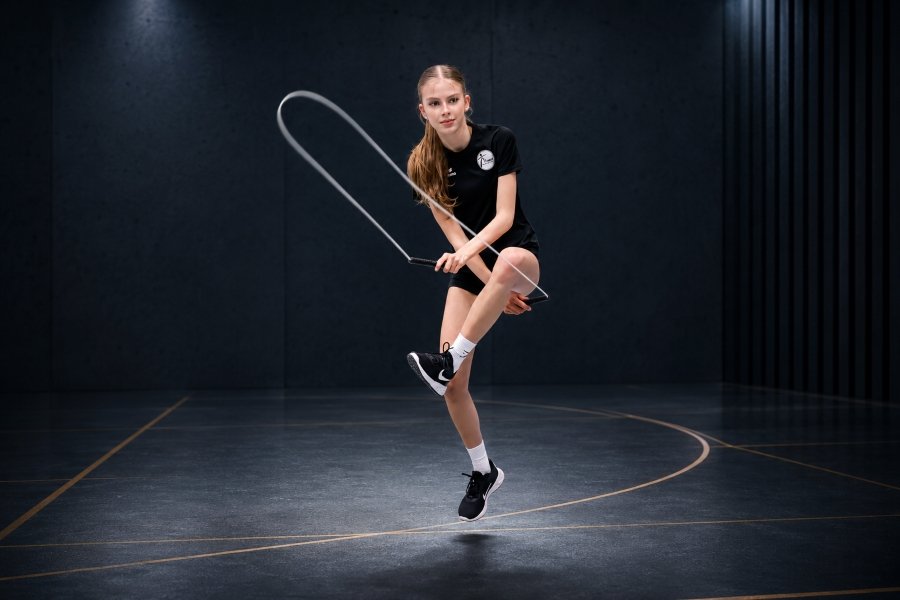
What the sport also does, and what rarely comes up in the contexts where her name tends to appear now, is teach you something specific about failure. It happens in front of people. It is unambiguous. And if you stay in it long enough, you learn that your relationship with a bad day matters more than the day itself.
That turns out to matter quite a lot.
This year, at the Hessian Championships, her main event day went badly. Not a little badly. Badly enough that, without a second option, she would not have competed in any discipline at all. The second option exists, a re-qualification round that competitors can choose to enter on their own initiative, but it is optional, and it is uncomfortable, and she is the one who keeps choosing it. She went alone. No one else from her club made the same choice.
In the re-qualification round, she came within roughly nine points of qualifying for the German Championships in her age group and went on to take the federal title in the three-minute speed event. She placed third overall in her age group.
The previous year, when she had such a bad cold that she and her mother went to the doctor beforehand to confirm she was cleared to compete, because she was determined to jump regardless, she re-qualified and became Federal Finals Champion overall.
There is a pattern here more revealing than either result on its own. When a day goes wrong, her instinct is not to accept the outcome. It is to find the next available route back into the contest and take it, alone, without anyone else setting the precedent. She does not appear to process a bad start as the final word. At fifteen. In a sport where failure happens in public and the results are immediate.
The online side of her life runs alongside all of this rather than instead of it. The Instagram and TikTok presence, over 125,000 on the former, 19,000 on the latter, maintained across German and English, reads less like a managed persona and more like a running record of what she is actually doing. Training. Competitions. Editorial shoots that have started appearing with increasing regularity. The occasional moment that is just being a person her age.
Growing up with an audience is its own specific condition. The decisions you make at fifteen are permanent and searchable in a way they were not for anyone a generation earlier, and there is something in how she uses the space that suggests she is aware of this without being paralyzed by it. She posts consistently without posting constantly. Nothing performs spontaneity. The German and the English coexist without one feeling like a translation of the other, two separate registers, two separate relationships with two different audiences, held simultaneously. That is harder than it looks and rarer than it should be.

She is doing several things at once, doing them with a seriousness that is legible without being announced, and not pretending to have resolved the question of what it all adds up to.
What makes her worth writing about is not the accumulation of things she is doing. Lists of things teenagers are doing are not interesting. What makes her worth writing about is the absence of the performance of certainty about where all of it is going.
She is not presenting a destination. She is not packaging herself toward a future she has already decided on. She is doing several things at once, doing them with a seriousness that is legible without being announced, and not pretending to have resolved the question of what it all adds up to. Most people, most adults, most definitely, find that unresolved state uncomfortable enough to either abandon some of the things or build a narrative around all of them that makes the direction look inevitable. She appears, at least for now, to be doing neither.
The shape is still forming. The re-qualification round is still being entered alone. The homework is presumably still due tomorrow.
Whether she will sustain this, the simultaneity, the refusal to perform certainty, the willingness to be mid-process in public, is not yet knowable. But right now it is the most interesting thing about her. Not the title. Not the following.
The fact that she went back in when she didn’t have to.