
By: Michael Grey
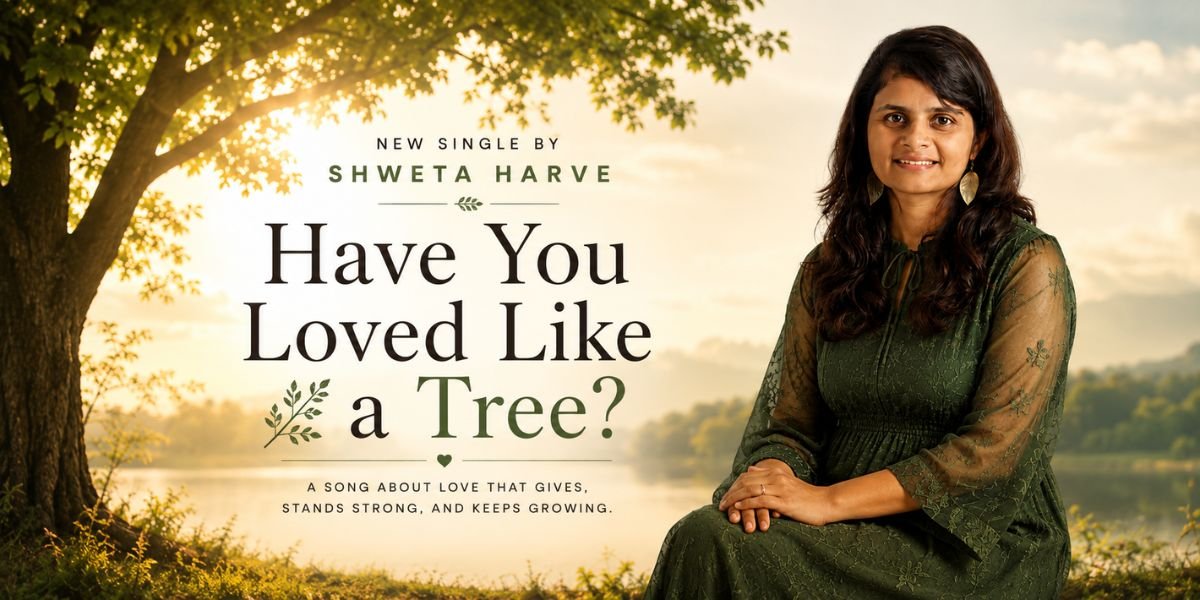
Popular music has always found its prophets in unlikely places. A train whistle. A motel room. A street corner. A broken heart. Shweta Harve’s Have You Loved Like a Tree? chooses something even older, something that has stood silently through every revolution humanity has managed to invent: a tree.
It’s a curious proposition. Trees don’t speak, campaign, advertise, or accumulate followers. They simply endure. They witness civilizations rise and disappear beneath their branches. In a century increasingly measured by notifications, deadlines, and digital applause, Harve offers a question that sounds almost ancient: What if love looked more like that?
The title isn’t merely poetic. It’s disruptive.
For decades, popular music has celebrated love as conquest, heartbreak, obsession, ecstasy, or escape. Love races toward someone or runs away from someone. It burns. It crashes. It explodes. Rarely does it remain still.
Harve proposes stillness.
That alone feels quietly radical.
The song unfolds with remarkable patience, refusing nearly every convention of contemporary production designed to keep listeners from reaching for the skip button. There are no oversized drops waiting around the corner. No dramatic key changes engineered for maximum emotional extraction. Instead, the arrangement settles into itself the way morning light slowly fills a room.
Acoustic instruments establish the setting with understated confidence. Piano phrases drift through the mix almost like passing thoughts. Gentle rhythmic foundations never insist upon themselves. Every musical choice appears dedicated to preserving space rather than filling it.
That restraint isn’t an absence of ambition.
It’s discipline.
Modern production frequently mistakes abundance for richness, layering sound until every available frequency competes for attention. Here, silence remains part of the composition. The pauses matter. The breathing matters. Even the smallest instrumental gesture seems to acknowledge that reflection requires room to exist.
Harve’s vocal performance follows the same philosophy. She never attempts to overpower the song’s message through sheer technical display. Her delivery remains measured, conversational, quietly assured. Rather than standing above the arrangement, she inhabits it.
That distinction changes everything.
Because the song isn’t asking listeners to admire its construction.
It’s asking them to examine themselves.
The tree functions as both metaphor and mirror. It offers shade without calculating return. It survives storms without announcing resilience as personal branding. It continues growing despite seasons of apparent stillness. Somewhere inside that image lies an uncomfortable contrast with a culture increasingly organized around visibility, productivity, and perpetual motion.
The song never states that outright.
It doesn’t have to.
Its questions perform the work that declarations cannot.
There’s an older tradition hiding beneath Have You Loved Like a Tree?, one that reaches beyond popular songwriting into parables, folk wisdom, and oral storytelling. The greatest folk songs rarely offered complicated solutions; they carried simple images that listeners unpacked across generations. A river. A road. A mountain. Here, the tree joins that lineage.
Its meaning shifts depending on who’s listening.
One listener hears environmental stewardship.
Another hears parenthood.
Someone else hears forgiveness.
Another hears faith.
The song remains remarkably open without becoming vague. That’s a difficult balance to achieve.
The production reinforces that openness by resisting obvious emotional cues. Rather than manipulating listeners toward predetermined feelings, it allows mood to emerge gradually through texture and pacing. Warm acoustic tones dominate the mix, giving the recording an organic quality that feels increasingly rare within digitally polished contemporary music.
Nothing sounds accidental.
Nothing sounds overworked.
The song’s greatest accomplishment may be its refusal to hurry toward significance. It trusts repetition. It trusts atmosphere. Most importantly, it trusts the listener’s willingness to remain present long enough for meaning to develop.
That confidence feels almost countercultural.
Popular culture often treats contemplation as inefficiency. Every platform rewards acceleration. Every algorithm prefers reaction over reflection. Even music has become increasingly optimized for instant emotional accessibility.
Have You Loved Like a Tree? Quietly declines the invitation.
Instead, it asks whether patience itself might still possess artistic value.
That’s a larger question than the song initially appears to pose.
Like much worthwhile art, its subject extends beyond its immediate narrative. The tree becomes less a botanical image than a philosophy of living. Growth happens invisibly before anyone notices it. Strength accumulates slowly. Generosity becomes meaningful precisely because it asks for nothing in return.
These aren’t fashionable ideas.
Perhaps that’s exactly why they matter.
Harve has increasingly established herself as an artist interested less in documenting contemporary life than interrogating it. Rather than merely reflecting the emotional atmosphere of the moment, her songwriting consistently searches for alternatives. Mindfulness instead of distraction, connection instead of isolation, reflection instead of reaction.
This latest work may represent the clearest expression of that artistic impulse.
It doesn’t reject the modern world.
It simply asks whether we’ve mistaken movement for progress.
By the song’s conclusion, no grand revelation has arrived. There are no definitive answers waiting beyond the final chorus. Instead, the question continues echoing after the recording ends, quietly accompanying listeners back into their ordinary routines.
That’s where its real power resides.
Not in the recording itself, but in the silence that follows it.
If the most enduring songs become part of the way we think rather than merely part of what we hear, then Have You Loved Like a Tree? has already begun planting roots. It offers no manifesto, no sermon, no certainty, only an image so deceptively simple that it becomes difficult to forget.
And perhaps that’s always been the work of the best songs. Not to tell us what the world is, but to leave us seeing it differently.