
By: Leslie Banks
Somewhere along the line, rock music got embarrassed by sincerity.
Everybody wanted another layer of irony, another wink, another carefully curated pose that said, Don’t worry, I don’t actually mean all this. Faith got filed away into niche markets, rebellion became branding, and the raw nerve that once made rock and roll dangerous started getting anesthetized by self-awareness.
Then along comes Ashes Awaken with “Hallelujah,” and they don’t just throw sincerity back into the room; they crank it through a stack of amplifiers until the walls begin to shake.
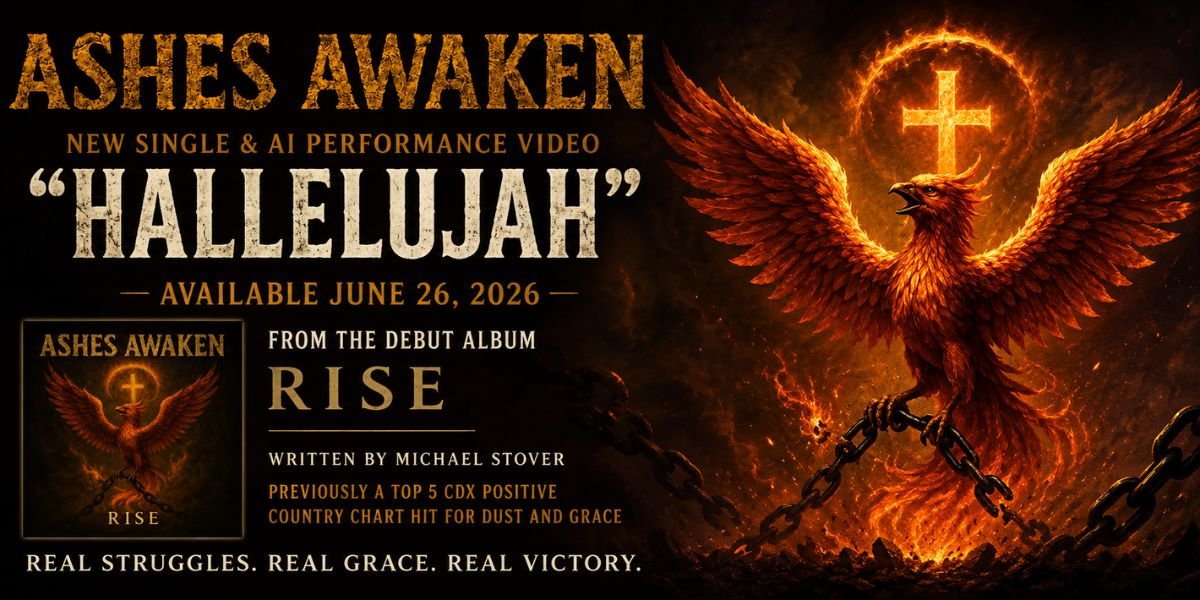
The funny thing is, this song has already lived one life. Written by Michael Stover, it first found success as a Top 5 CDX Positive Country chart hit for his project Dust and Grace. In another artist’s hands, it was a country testimony. Here, it’s been reborn as a full-blown Christian metal anthem, and the transformation feels less like a genre experiment than a revelation.
The opening doesn’t creep toward its destination. It charges.
I wanna sing something to ya I wanna sing hallelujah…
That’s it. No psychological maze. No cryptic poetry designed to impress graduate students. Just the oldest instinct in music itself: somebody has experienced something life-changing, and now they can’t shut up about it.
Imagine that.
The guitars arrive with enough muscle to flatten buildings, but they’re never there simply to prove how heavy the band can be. Every riff serves the song. Every drum hit pushes the message forward. The arrangement understands something that too much contemporary metal forgets. Dynamics aren’t about volume alone. They’re about conviction.
And conviction is what fuels every second of “Hallelujah.”
When Stover sings,
I wasn’t born a believer, I was a desperate deceiver Until I found my Redeemer…
He’s doing something that’s become almost radical in modern rock: admitting transformation without apology.
No hedging.
No fashionable uncertainty.
No “maybe.”
Just a man standing in front of a microphone saying, “Here’s who I was. Here’s who I am now.”
Whether you agree with his theology almost becomes irrelevant because the emotional honesty is undeniable.
That’s the strange magic happening here. This isn’t praise music trying to imitate heavy metal. This is heavy metal discovering that praise can be every bit as explosive as rage.
Rock has always been built on release.
The Who smashed guitars.
The MC5 screamed for revolution.
Punk spat in authority’s face.
Ashes Awaken simply points that explosive energy somewhere else. Instead of tearing something down, they’re building something up. The emotional mechanics remain exactly the same.
The chorus repeats the word “hallelujah” until repetition itself becomes transcendence. Some listeners will hear simplicity. Others will hear hypnosis. The best gospel music has always understood that repeating truth isn’t redundancy. It’s meditation. By the fourth or fifth “hallelujah,” you’re no longer analyzing the lyric. You’re inside it.
That’s a trick churches have known for centuries.
Metal just happens to provide bigger speakers.
Musically, the band threads an interesting needle. You can hear modern Christian metal influences in the guitar attack, but there are flashes of classic melodic craftsmanship underneath. The choruses are built to soar rather than merely crush, suggesting someone who grew up understanding that Queen, Journey, and Boston knew a thing or two about writing hooks that survive generations.
That melodic instinct keeps the song from collapsing under its own weight.
Then there’s the line that quietly carries the whole thing:
Everybody praises the Lord.
On paper, it almost seems too direct.
In practice, surrounded by walls of distorted guitars and drums that sound like thunder rolling across steel mills, it becomes oddly defiant. In a culture terrified of saying anything with complete certainty, Ashes Awaken plants its flag without asking permission.
That kind of confidence can make people uncomfortable.
Good.
Rock music was never supposed to make everybody comfortable.
“Hallelujah” succeeds because it never mistakes complexity for depth. It understands that the hardest thing any songwriter can do is tell the truth plainly enough that nobody misses it. Stover doesn’t hide behind metaphor when gratitude will do. He doesn’t bury faith beneath clever wordplay. He simply sings it with enough force that even skeptics have to acknowledge the conviction behind it.
This is a song that believes every note it plays.
In an era drowning in calculated authenticity and algorithm-friendly mediocrity, that’s almost revolutionary.
“Hallelujah” isn’t trying to convert heavy metal into worship music.
It’s reminding us that sometimes the loudest sound a guitar can make isn’t rebellion.
Sometimes it’s gratitude.