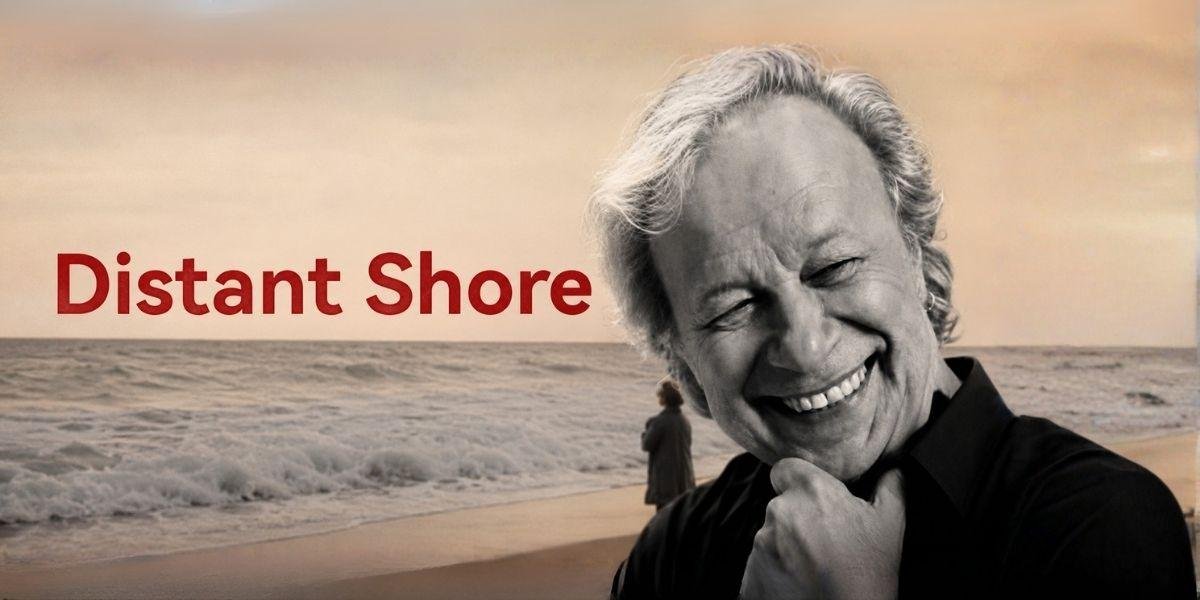

For much of popular music history, songs about migration have tended to fall into one of two categories: the romanticized journey or the political statement. What makes Harry Kappen’s “Distant Shore” so striking is that it largely rejects both approaches. Instead, it occupies a more difficult space, one where uncertainty becomes the central emotion, and where survival itself is the story.
The song, taken from Kappen’s current album After the Crossing, arrives with a premise that feels almost impossible to condense into four minutes. Inspired by refugees forced to flee war, poverty, and dangerous living conditions, “Distant Shore” seeks to imagine the emotional reality of leaving home behind with no guarantee of reaching safety. Yet rather than framing the subject through politics or ideology, Kappen narrows his focus to the small details that make displacement feel devastatingly personal.
That choice gives the song its power.
From its opening lines, “Distant Shore” places listeners inside the experience rather than outside observing it. The lyric “I kiss the door I can’t replace” functions as a kind of emotional thesis statement. Home isn’t represented as a nation, a border, or an identity. It’s a doorway. A familiar object. Something ordinary that suddenly becomes precious because it may never be seen again.
Throughout the song, Kappen continues working at this scale. There are no sweeping speeches or broad declarations. Instead, there are crowded vehicles, endless nights, prayers whispered in exhaustion, and waves that rise “like concrete walls.” The imagery remains tactile and immediate. You can almost feel the claustrophobia.
Musically, “Distant Shore” is built on atmosphere rather than momentum. The arrangement unfolds slowly, guided by a floating mellotron that immediately evokes comparisons to David Bowie’s “Space Oddity.” Kappen has acknowledged Bowie’s influence, and the connection is undeniable. But while Bowie used space travel as a metaphor for alienation and detachment, Kappen uses physical migration as a lens for exploring vulnerability and hope.
The production is remarkably disciplined. In an era when independent artists often overproduce in an attempt to compete with major-label releases, Kappen takes the opposite route. The instrumentation serves the narrative rather than calling attention to itself. The keyboards drift gently through the mix. The guitars shimmer at the edges. The percussion pulses with quiet urgency.
Everything feels suspended.
That sense of suspension is reinforced by Kappen’s vocal performance. He doesn’t approach the song as a dramatic actor inhabiting a role. Instead, he sings with measured empathy. His voice carries concern and reflection rather than outrage. There’s a softness to his delivery that prevents the material from becoming exploitative.
That restraint is essential because “Distant Shore” deals with suffering without trying to sensationalize it.
The chorus, centered around the repeated question “Where is that distant shore?”, becomes the song’s emotional anchor. It functions on several levels at once. Within the narrative, it is a literal destination, a safe place beyond danger. But it also operates as a broader metaphor for stability, belonging, and hope.
Importantly, the song never answers the question.
There is no triumphant arrival. No guarantee of rescue. No neat resolution waiting at the end.
That ambiguity feels honest.
Part of what makes “Distant Shore” resonate is Kappen’s own perspective. Following his move from the Netherlands to Mexico, he became increasingly aware of the privilege involved in voluntary migration. Rather than centering his own experience, however, he uses that awareness as a point of contrast. His journey becomes a reminder of how profoundly different forced displacement can be.
That distinction gives the song moral clarity without turning it into a sermon.
Kappen’s background as a music therapist also seems relevant here. His songwriting demonstrates an unusual degree of emotional intelligence. He understands that empathy is most effective when it creates space rather than demanding agreement. “Distant Shore” invites listeners to inhabit another perspective without instructing them what conclusions to draw.
In a music scene often dominated by immediacy and spectacle, that approach feels refreshing.
What remains after the song ends is not a policy argument or a headline. It is a feeling, one of movement, uncertainty, fear, and fragile determination. Kappen transforms those emotions into a carefully crafted piece of atmospheric rock that is both deeply personal and quietly universal.
“Distant Shore” doesn’t pretend to solve anything. It simply asks listeners to imagine what it means to keep moving toward a horizon you cannot yet see.
Sometimes, that is enough.